
Frankly, making the decision to go solar in India nowadays somewhat resembles standing before a gigantic tech buffet. There is an overwhelming amount of options, the abundance of technical jargon, and to be honest, the plethora of people who want to sell you “the next big thing”. But when you finally make the decision to buy solar panels online India, remember you are not simply purchasing a piece of glass and silicon; you are making a commitment that will last for the next 25 years of your life (or the profit of your business).
My “Scorching” Lesson: Why Paper Specs Aren’t Always the Truth
It was at the very start of my tenure as a project lead when we decided to implement a pretty large solar system at a textile mill in Gujarat. The procurement team was over the moon, they had found a bargain online. The solar panels seemed perfect from the PDF datasheet, the price per watt was unbelievably low, and the salesperson assured us they were “top-tier”.
Eight months onward, deep into a scorching Indian summer. Power output dipped sharply across three lines. Up on the roof, thermal lens in hand, what showed up shocked us – panels glowing bright, like holiday bulbs strung too close. Hotspots burned through multiple cells. Inside, joints where wires met were poorly fused, weak. Glass labeled tough cracked fine, spiderweb thin, unable to handle heat swell and shrink. Fifteen percent of the setup got replaced within twelve months – pressure made that move unavoidable. What seemed cheap at first actually drained nearly double the resources, thanks to downtime and extra hours spent fixing it.
A lifetime of learning came from that moment. In India’s solar industry, believe if you must – yet check once, then check twice.
1. The “Silicon Soul”: Technology Choice for 2026
When you go shopping to buy solar panels online India, the first thing that will overwhelm you is the technical jargon. Mono-PERC? TOPCon? Bifacial? It’s enough to make your head spin. But hey, here’s the reality for the Indian climate.
Why TOPCon and N-Type Cells Are Leaders
Mono-PERC was the uncontested leader if you were buying 2-3 years ago. It’s still a great technology, I am not saying it’s not. However, as we approach 2026, TOPCon (Tunnel Oxide Passivated Contact) technology is the one that will be recognized as the new standard for anyone serious about EBITDA.
Simply put: with the intense sunlight of Rajasthan making your flip-flops melt, the TOPCon solar modules will retain their efficiency much better than those of the older technologies. They also feature lower LID (Light Induced Degradation), which means that they don’t “wear out” as fast in the initial months of use.
Should You Go Bifacial?
Bifacial panels are widely advertised these days.
- Pro Tip: If you have a flat, white-painted concrete rooftop or a ground mount system surrounded by reflective surfaces, bifacial can give you a 5, 15% uplift in yield.
- Reality Check: If you are going to install them flush against a dark, sloped metal roof, you are basically paying extra for a feature you won’t be able to use.
2. The Paper Trail: Certifications That Actually Matter
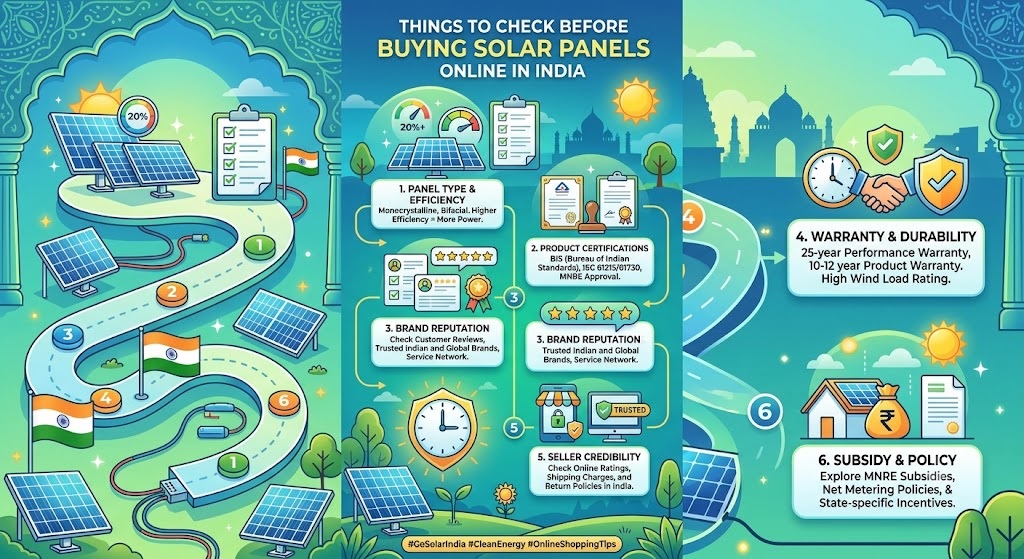
I have seen such cases quite frequently, a listing that claims “Internation Quality” or “Certified for Safety”. To be honest, such phrases don’t mean anything unless the actual data comes along with them. You cannot afford to ignore two “must-have” mandatory requirements in India if you want to buy solar panels online India.
AlmmAndBis Dual Protection
Start by checking the ALMM – short for Approved List of Models and Manufacturers. The Ministry of New and Renewable Energy, or MNRE, maintains it. To qualify for government subsidies or net metering benefits, your solar equipment maker has to appear here. Without their name on that list, access gets blocked.
- Got a question? Insist on seeing the precise ALMM registration number from any internet seller. Hesitation shows up? Turn around without another word.
- These days, selling solar panels in India means they must carry BIS certification – rules have required it since 2018. Panels missing this mark fall short on essential safety checks. Without that stamp, a module simply does not meet minimum standards.
Global Standards (IEC)
If you want “world-class, ” then look out for IEC 61215 (for design/performance) and IEC 61730 (for safety). These are not just attractive badges; they really mean that the panel has undergone tests like being pelted with hailstones, heated in ovens, and exposed to UV light in a laboratory.
3. The Warranty Trap: 25 Years is a Long Time
Every solar panel ad shouts “25-year Warranty!” At least to me, a warranty is only effective as the company behind it. Suppose a brand-new “fly by night” assembler disappears in three years, a 25-year warranty paper in such a case would just be a costly piece of paper.
Getting to Know the Two-Part Warranty
- Product Warranty: It is the warranty that covers the hardware defects such as frame rust or junction box failure. It is typically issued for 10-12 years.
- Performance Warranty: The performance warranty that normally is for 25 years guarantees that the product will still produce, say, around 80-85% of the original output after two and a half decades.
Red Flag: If an online store does not explain the differences between the two, they are probably hiding a weak product warranty. I have seen solar panels that had a 25-year performance warranty but only a 2-year product warranty. If in the third year the glass shatters due to a manufacturing defect, then there would be no one you can turn to for help.
4. Physical Red Flags: Checking Out Your “Digital” Goods
When you buy solar panels online India, you won’t have a chance to feel and see the product before it is delivered to you. That is why you have to become a bit of a detective who is not only good at analyzing photos but also technical datasheets.
- Busbars (The “Silver Lines”): Always look for “Multi-Busbar” (MBB) technology. The old solar panels had only 2 or 3 thick lines while contemporary panels have 9 to 16 thin wires. The more busbars a solar panel has, the shorter the distance electrons have to travel and the less power is wasted because only a small part of the solar cell is shaded.
- Half-Cut Cells: If a solar panel looks like it has twice the number of cells (but they are smaller), then it is a “Half-Cut” module. Such panels are much better at handling partial shading. For example, if a bird dropped poop on the upper half of a conventional solar panel, the entire cell might stop producing electricity. However, a half-cut solar panel will continue to supply power from the bottom half.
- The Junction Box: Its rating should be IP68. In India, there are monsoons that feel like someone is purposely aiming a firehose at your roof. A rating less than IP68 will definitely result in water ingress and a subsequent short circuit.
- The Logistics Nightmare of Shipping Glass Across a Subcontinent
- Funny how we overlook the fact that solar panels are basically just thick, weighty sheets of glass. Since they get shipped straight from online orders, bumping along India’s rough highways becomes unavoidable – and honestly, anyone who’s seen those roads can guess what happens next.
- A cracked solar panel shows up. Someone has to decide whose job it is to prove when damage happened. Unboxing footage settles that. Businesses usually call this transit insurance. Buyers working with companies should confirm the deal includes coverage. That means either CIF terms apply. Or the seller directly accepts repair costs for shipping harm.
- A tiny hidden crack might live inside a solar panel even if the outside looks perfect. A drop during shipping could harm the inner cells without showing any sign. When possible, getting someone nearby who knows tech stuff to run a flash check helps. At minimum, let them look closely all over after delivery. Spending on that check makes sense more than most think.
6. Assessment of the Seller: Brand or Reseller?
Three main types of stores are available when you want to buy solar panels online India:
- Direct Manufacturer Stores: (e.g. Tata Power, Adani, Waaree). The safest bet as far as warranty is concerned.
- Authorized Distributors: These are quite good if you want to buy a complete off-grid solution (solar panels+inverters+cables) at one place.
- Third-Party Marketplaces: these sellers can be unreliable; they are a gamble.
Pro Tip: You should thoroughly check the seller’s Indian market track record.
For how long have they been operational 5 or 10 years at least? Do they have a service network in your state? In case you reside in Kerala and the seller is located only in Delhi with no local partners, then getting a technician out to your place for a warranty claim will definitely be a nightmare.
7. Don’t Forget the “Supporting Cast” (Cables & Structures)
It just feels like people spend ages choosing the panels to the last detail and then practically the next day, they buy the cheapest wires available in the market. I’d beg you, please, not to fall into that trap.
- Solar Cables: Use UV-resistant, DC rated copper cables. Normal household wiring when exposed to the Indian sun will disintegrate in less than two years.
- The Structure: If you are buying a “kit” online, you should examine the material of the mounting structure. It has to be that of Hot-Dip Galvanized (HDG) Steel or top-quality Aluminum. If the material is just mild steel and simply painted, it will turn into a heap of rust by the time the third monsoon arrives and your costly solar panels might literally be blown off the roof during the next storm.
Conclusion
Going solar is such a smart decision in the end, both environmentally and financially.
Traditional brick-and-mortar stores are nowhere near that level of quality as the Indian online marketplace which is maturing day by day, and you can already grab some incredibly good offers once reserved for the utility giants only.
That said, if a deal looks like it’s out of this world, for instance, 30% less than the other brands that have a solid reputation, it most probably is.
It could perhaps be thinner frames, Grade B cells (cells with minor visual defects), or simply that the company won’t be there to answer your calls in 2030.
Purchase wisely. Check the paperwork thoroughly. And get professional installation once you buy solar panels online India. Because even the strongest panel won’t produce anything if installed facing North or connected with cables that are too thin.