

Every procurement engineer in oil and gas has a story about a batch that looked fine on paper. The certificates were stamped, the dimensions sat inside tolerance, the price was good. Then a body cracked during hydrotest, or worse, a few months into service. By then the supplier had gone quiet and the rig schedule was wrecked.
Stories like that are why audits and independent inspection became standard practice. They are also the quickest way to find out which forged oilfield components suppliers really run a controlled shop and which ones just have good paperwork.
Paper Only Goes So Far
A material test certificate is a claim. Someone in the supplier’s lab says the steel had a certain chemistry, hit a certain yield strength and passed a certain impact test. Whether that’s true depends on a long chain of small things. Was the furnace thermocouple calibrated? Did the coupon sit in the same load as the forging? Did the person reading the Charpy results know what a bad fracture surface looks like?
Most of the time the answers are yes and nothing goes wrong. But wellheads, tubing hangers, valve bodies and BOP parts don’t get second chances. A coarse grain structure or a missed hardness spike can sit quietly inside a forging for months. Checking the certificate tells a buyer what was reported. Checking the shop tells a buyer how those numbers were produced.
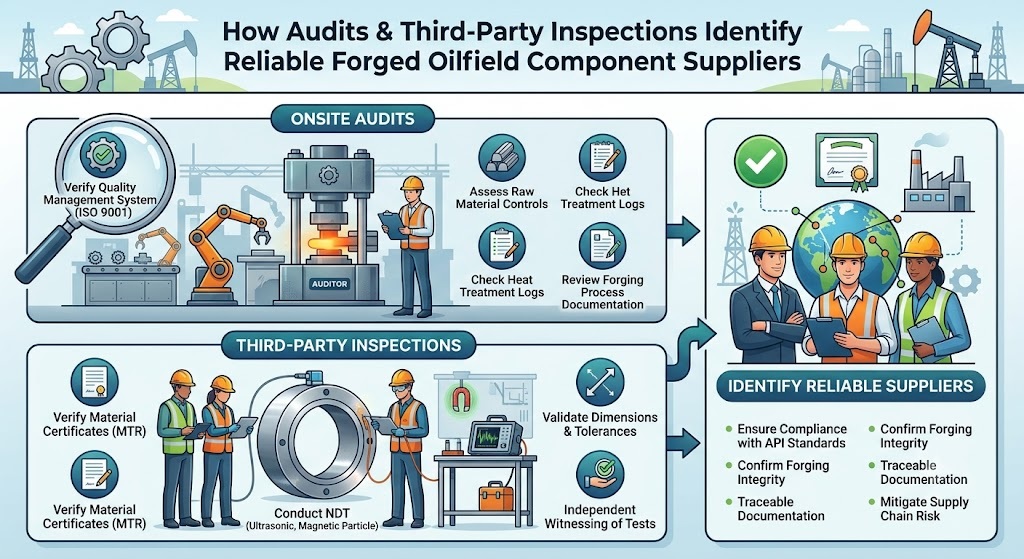
What Gets Checked in a Pre-Qualification Audit
The audit happens before the first order. A small team from the buyer, sometimes with a consultant, spends a day or two walking the plant and going through records. The good ones follow a forging from raw bar to the packing bay.
Start with the quality system. ISO 9001 is the baseline. For petroleum equipment, auditors usually want API Q1 as well, and for certain products a valid API 6A or 16A monogram licence. Holding the certificates is the easy part. Auditors dig into internal audit reports, how customer complaints were handled, and whether corrective actions were really closed or just marked closed.
On the floor, attention goes to the press, the furnaces and the quench. Furnace survey records matter a lot here. A furnace running 20 degrees hot in one corner will give uneven properties across a load, and the paperwork won’t show it unless somebody ran the survey. Auditors also check how test coupons are marked and linked to parts, because a coupon that can’t be traced back to a specific forging is worth nothing.
The lab comes next. Hardness testers, tensile machines and impact equipment need current calibration, and the people using them need training records. NDT personnel should hold valid certification, normally ISO 9712 or ASNT, and work to procedures that match the customer’s specification.
Last is traceability, and the test is simple. Pick a forging off the yard and ask for its history: heat number, melt source, heat treatment chart, test results. If the file shows up in ten minutes, good. If someone disappears for half a day, that says plenty.
What Third-Party Inspection Brings
An audit looks at the system. Inspection looks at the actual product on a specific day. Independent agencies such as Bureau Veritas, SGS, TÜV, DNV or Lloyd’s Register send inspectors who answer to the buyer. Nobody at the supplier signs their pay cheque, which is the whole point.
Requirements usually live in an inspection and test plan attached to the purchase order. Some steps are marked as witness points, meaning the inspector wants to be there. Others are hold points, meaning production stops until the inspector signs off. Heat treatment loading, tensile and impact tests, ultrasonic testing of critical sections and final dimensional checks are the usual candidates.
Inspectors also notice small stuff. Stamped heat numbers that don’t match the paperwork. Gauges with expired calibration stickers. Rejected parts lying around untagged. After a few visits, patterns appear. Suppliers who are comfortable with the process treat inspectors like part of the routine. The shaky ones start asking whether a certain test can be waived this time.
About Shailesh Forging Works
Shailesh Forging Works is a forging manufacturer serving industrial and energy customers, oil and gas included. Anyone who wants to see its product range, processes and capabilities can check the company homepage.
Red Flags Worth Spotting Early
Some warning signs show up before any audit starts. Reluctance about visits is the big one. If a supplier keeps pushing the date, limits which areas can be seen or offers only photos, that’s information.
Others are quieter. Certificates where every heat shows almost identical numbers. Heat treatment or testing quietly sent to an outside shop. Calibration records with gaps. And a habit seen with weaker forged oilfield components suppliers: technical questions get answered with a brochure. Ask what hardness range came out on the last sour-service batch. A solid shop pulls up the data in a minute. A weak one talks about how many years it has been in business.
Setting It Up Without a Big Team
Smaller buyers sourcing from forged oilfield components suppliers sometimes assume this needs a full quality department. It doesn’t. A short questionnaire weeds out the obvious mismatches. Audit the two or three that remain, using the same checklist for each so scores can be compared fairly.
Once a supplier is approved, the inspection plan goes into the order from the start. Name the agency, the witness and hold points, and the documents needed at dispatch. Rework or deviations need written approval beforehand, not an explanation afterward. Low-risk items can run on a lighter plan, but anything pressure-containing deserves the full treatment. Re-audit every two or three years, or sooner if the supplier changes furnaces, ownership or process.
It costs money. Travel for audits, inspector fees, extra days in the schedule. Compare that with one rejected batch found at the rig and the numbers look different.
Conclusion
Any supplier can say it’s reliable. Audits and independent inspection are how buyers check. The audit shows whether the system works when nobody important is looking, and the inspector confirms that what leaves the gate matches what the paperwork says.
For anyone buying wellhead, valve or drilling forgings, picking from forged oilfield components suppliers that accept both checks without fuss is the most practical way to lower risk. The ones that pass tend to keep passing, and every clean delivery makes the next order easier to place.

