
Rail industry forging companies are changing the way railroads function through the provision of durable and reliable rail parts. A forged railway parts manufacturer  utilizes advanced forging technologies as well as superior materials and heat treatment process in production of railway parts to ensure they can endure heavy stress and vibration. Many railway items, such as axles, wheels, rails, couplings, etc., are manufactured and supplied to railways by forging industry. Furthermore, modern technologies favor creation of better quality products, reduction of damage, and assurance of constant manufacturing standards in production of railway components.
Why Are Forged Railway Parts Essential for Modern Railway Systems?
Forged railway components are highly important for modern railways because of their great strength and durability as well as resistance to heavy loads, impacts, and continuous vibrations. These parts are produced by forging processes, which involve applying pressure to the metal thereby enhancing its mechanical properties and reliability. Railway wheels, axles, couplings, and connecting rods are examples of parts that deserve reliability under harsh operating environment. The components give engineers and operators access to a combination of reliability and low maintenance requirements. On the other hand, forged parts guarantee uniform quality of the passenger and freight railway cars as well as of all railway network components.
How Are Forged Railway Components Manufactured for Heavy-Duty Applications?
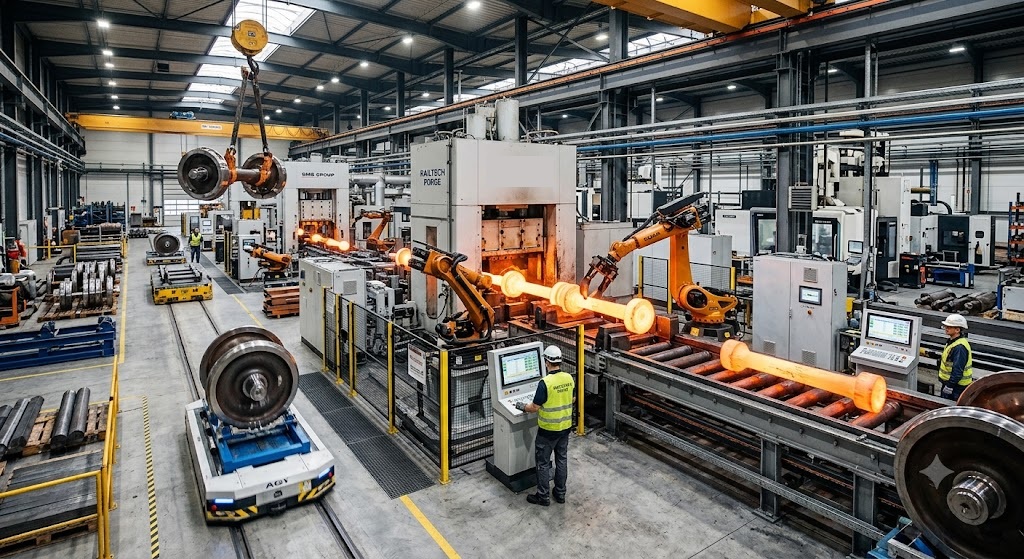
The technique of producing forged railway parts involves various processes arranged to create items that are strong and durable, with performance suitable for some heavy-duty tasks. First of all, the metal is chosen according to the load it must bear and other operational characteristics. Subsequently, it is heated to the appropriate temperature and shaped with the help of either presses or hammers. And only after the forging itself goes the process of heat treatment, as it enhances hardness and makes the product more resistant to wear. Next comes precision machining to achieve the necessary dimensions, and inspection processes involving non-destructive tests to check for quality and possible defects. All these steps help manufacturers of forged railway parts make sure that their products are safe and suitable for use in wheels, axles, couplings and other details exposed to heavy weights and stress during operation.
Conclusion
Forged railway parts manufacturers have shown a strong contribution to the future of railway industry by providing resilient, robust, and precision-designed products for railways. Various sophisticated production methods like advanced forging, heat treatment, machining, and quality assurance are the secret to achieving this goal and producing railway parts capable of handling heavy loads and unfavorable working conditions. With such advanced manufacturing methods, it is possible to enhance safety and reliability of railway systems and make engines work longer. As an increase in railway infrastructure is ahead of us, the need for forged railway parts will still be there.