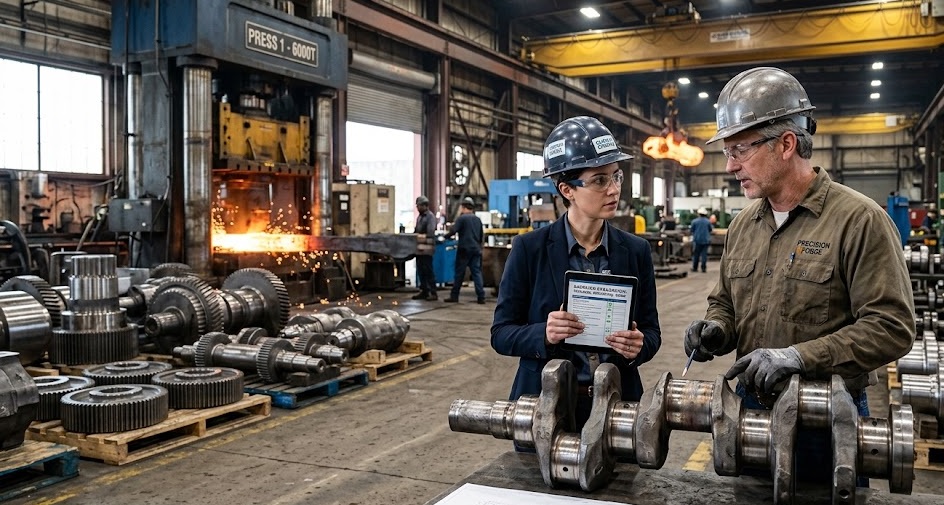

As a junior procurement lead in Pune, I got my first week. We were working in the middle of a new crankshaft assembly deadline. In order to save some money, I went with a local shop that was promising at a price 15% below the market. I thought I was a hero that day- until the first batch arrived. Half of the parts have internal cooling cracks that cannot be seen with the naked eye but are so severe they get destroyed by a load test. I must say, it was a very pricey and costly lesson for me personally learning it the hard way. It was not just a matter of money but it was also true to the two-week shutdown. I condemned my “hero” moment which turned into a nightmare so quickly.
In the domain of heavy industry, be it Rajkot, Ludhiana or even sourcing globally for a gigantic infrastructure project, the situation is mostly unchanged: the final product is only as good as the quality of the steel inside it. Finding a reputed steel forging supplier is more than just ticking a box on a spreadsheet; it is an investment in the brand’s reputation for strength and scale.
The Strategic Foundation: One Step Further than the Price
The first thing that you should keep in mind when making a choice about your suppliers, that steel forging is not only a technical process but also a form of art. I mean, anyone with a furnace and hammer can “shape” metal. But truly forging? That is about controlled deformation to enhance the mechanical properties of steel. You should have a supplier whose mind is in the same place as yours.
Meeting Metal Working Requirements
Hold on. Start with the details, not the obvious. Get clear about your actual goal. Think tight-tolerance mass production – does closed-die fit? For massive custom shafts made once in a while, maybe open-die works better.
- Steel isn’t just one thing. Think again – carbon, alloy, or stainless makes all the difference. Heating times shift depending on which type shows up. One size fits none here.
- Picture the way fibers run through a cut of wood – this direction matters just as much inside metal. Instead of random patterns, expert suppliers shape steel so its internal grain follows the form of the piece being made. Because of that alignment, the material handles stress far better over time. What makes forgings last isn’t magic – it’s built into how they’re formed.
The Capacity Reality Check
I have spotted many times when a buy-side finding an excellent boutique forge suddenly faces the reality that the shop cannot scale when the order increases from 100 to 10, 000 units.
- Equipment Range: Verify their hammer and press capabilities. Are they sufficiently geared to handle your largest parts without over-stressing the machinery?
- Throughput: Turnaround time is crucial. As we have witnessed in the larger B2B arena, being first to market is a potent force. If they can’t act purposefully, they’re setting you back.
Vetting for Reliability: The “No-Nonsense” Checklist
Digital checks a must, but by no means the only criteria that needs to be evaluated. Very often companies just say, “we have world-class quality culture.” You need to make sure by asking for evidence and following up on delivery of tangible proof.
Quality Assurance and Certifications
Out there, across India and beyond, getting certified matters a lot. Not just sheets of paper – they’re proof, really, that someone neutral checked things and found order where it counts.
- ISO 9001:2015: Ensures quality management system is up to par.
- Meeting AS9100 means you’re set for aerospace work. When it comes to cars, IATF 16949 isn’t optional. Each sector sticks to its own rulebook. Without these, access slips away.
- When picking a supplier, think about where their lab work happens. Some handle tests inside, others send them out. Inside labs often mean each batch gets checked, not just one taken now and then. Regular scans beat occasional ones. Having control over testing can change how consistent results turn out. Not all companies test the same way. Monthly spot checks miss what daily runs catch.
Technical Prowess and R&D
You don’t just have to hammer out shape; you also have to think.
- Simulation Software: Ask if they use software like FORGE or DEFORM. Seeing a digital “virtual forge” before the first physical strike saves weeks of trial and error.
- Heat Treatment Excellence: Benefits from a well-executed heat treatment procedure substantially. If their heat-treat shop is a secondary concern, escape quickly.
The Price vs. Value Paradox: Don’t Get Burned
We need to discuss the “cheap” trap once again. Within the Indian industrial market, there will always be people willing to do the job for less. But at what cost?
The Hidden Costs of Poor Forging
When a supplier decides to cut costs, they most likely do it in the places that are hidden from the customer’s eyes:
- Usage of Substandard Raw Material
- Omission of Heating Cycles
- Not Properly Maintained Dies
Here’s something people miss: the number on the quote isn’t the whole story. A slightly higher price tag might come with far fewer defects. One vendor costs 5% extra yet delivers almost perfect parts. The bargain option? Three times as many flaws slip through. Those rejected pieces add waste, rework, delays – hidden expenses stack up fast. Suddenly, cheap food becomes costly. What seems pricier upfront often cuts losses downstream. Think beyond pennies; track what comes after delivery.
Scaling for the Future: Industry 4.0 and Beyond
It would be great if suppliers keep abreast with the changing world too. From my perspective, the ongoing disparity between “old-fashioned” and “smart” shops increases daily.
Technology as a Speed Multiplier
At the end of the day, technology is the key to faster and efficient functioning leading to more competitive products in the market, be it AI implementation or industrial manufacturing.
- Automation
- Real-time Monitoring
Sustainability in Global Markets
One thing stands clear now – buyers across the world care deeply about being green. Think of a forge: does it heat metal using modern induction rather than outdated gas flames? Then again, what happens to leftover waste pieces after shaping steel? Ignore eco practices, and doors slam shut on big international deals by 2030. Truth slips through – the shift has already begun.
Building a Long-Term Partnership
Uniting buyers and suppliers for a long-term purpose is a signal of strategy. Your steel forging supplier is ideally the one who complements your engineering team rather than just a mere order handler.
Communication and Transparency
- Project Management: Whether they are assigning you a single point of contact or you are being thrown from one department to another?
- Transparency: The real test of trust is that if a batch is going to be late, do they tell you three days before or three hours after the deadline?
Logistics and Supply Chain
Particularly in a geographical setup that is as vast as India or when dealing with international shipping, logistics is the one true king.
- Packaging
- Location
Conclusion
Picking a steel forging provider means weighing different things at once. Not just whether they can do the job, but if it makes sense cost-wise too.
- Truth is, when things get tough, you need a partner ready to act. Skip the cheapest offer if something seems wrong. Get the material test reports instead. Stop by their site whenever possible. Have conversations with customers already working with them.
- What keeps your product strong – be it a giant wind turbine shaft or a tiny tractor gear – comes down to the steel forged within. Skipping shortcuts here? Not wise. A solid base matters more than most admit. Someone standing firm beside you, matching your drive for consistency and size, makes all the difference. That kind of alignment doesn’t happen by accident.
- Out there, tough questions wait – pose them. A steady ally could emerge, someone to shape lasting work beside you. This is yours to hold.
Actionable Summary for Your Next Sourcing Meeting
Start by checking labels – ISI, ISO, or any required industry badges must be there. Missing them? That changes everything. Each mark tells a story of standards met, steps followed. Skip this step and trust vanishes fast. Look closely before anything else happens.
- Start by questioning how grains move through the process. Dive into which tools model those shifts. Probe deeper – what steps control temperature during hardening.
- Start by asking what happens if things go wrong. Figure out the price of breakdowns before picking the lowest offer.
- Start by looking at how well they handle expansion – equipment limits might hint at future hiccups. Their balance sheets could reveal more than promises do when years go by.
- Start by looking at how open they are. A team that shares info freely often moves faster when making choices based on facts. Their way of working should match clear thinking and honest communication. Speed matters only if it comes from reliable insights.