
Forging company in Rajkot ranks among the leading engineering hubs of India and provides precision parts to the automotive, machine tool and industrial sectors. Approximately 140 forging units make Rajkot an important centre for forged products in Western India. Closed die forging and ring rolling are the primary processes used in most of these units; however, open die forging is only found in a limited number of units and in specialised applications.
Industry Structure and Production Data
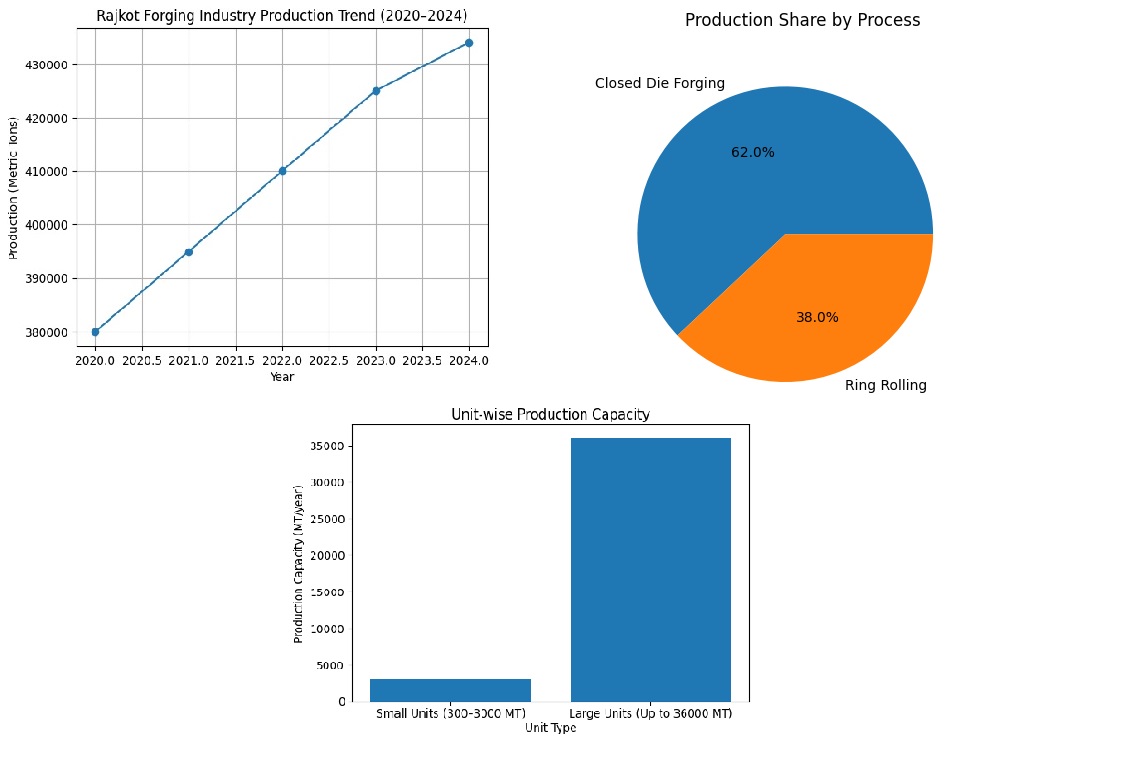
According to cluster analysis, there are approximately 140 businesses in the forging sector within Rajkot, which is composed of approximately 90 closed die forging companies and roughly 50 ring rolling companies, they produce approximately a total of 434,000 metric tons of products per year. The Closed Die Forgings comprise 62% of total production of approximately 268,548 Metric Tons/year and the Ring Rolling comprises 38% with approximately 165,663 Metric Tons/year. Industries generally make larger companies, normally equal in weight to 36,000 metric tonnes. Smaller firms operating in these industries usually produce somewhere between 300m and 2,500m metric tonnes annually. For example, total quantities produced from 2020 to 2014 have gone up consistently for the last 5 years and reach 434,000 metric tonnes in 2014, from 380,000 metric at the end of 2020, representing an increase of about 53,000 metric tonnes! The growth has been attributed generally to new or increased orders being received by OEMs which produce parts for automobile manufacturers, as well as from deeper penetration into international markets.
Open Die vs Closed Die Forging: Key Differences
By far the most widely used methods in the business of forging are the open die forging process and the closed die forging process. An open die forging, or do-it-yourself (DIY), means that when creating a piece of metal you are going to use two flat or reasonably simple dies to create your piece. Since you never fully close off or create a complete enclosure around the metal piece you are forging, this makes open-die forgings a good candidate for creating large and relatively simple parts, such as shafts, as well as heavy parts; however, the operator has to be skilled, and the finished product is not as precise as the closed die forged part, and tooling costs for open die collapsing will typically be lower than for closed-die forging. Closed-die forging uses special dies to completely enclose the material being forged; therefore, they can be made with very high precision, and provide the ability to produce parts repeatedly with very high uniformity and efficiency, particularly in the case of mass production of automobile or precision manufactured components, however, the cost of producing these dies are high compared to the cost of creating dies for open die forging. Open die may be very efficient and generally provide relatively low material utilization; in contrast, closed die provide significantly more efficiency, material utilization, and automated processes for producing parts.
Benefits of Open Die Forging
The advantages of open die forging rate fairly above many of those provided by other processes, especially considering things like heavier parts and the size constraints associated with closed die forging. Generally speaking, this type of forging offers several advantages – it’s relatively inexpensive due to its low startup investment, provides more design options as a result of being versatile in terms of how you produce components, and is therefore ideal for customizing parts or creating very large volumes at an affordable price. Additionally, closed die forging provides numerous benefits to manufacturers of parts in the OEM supply chain as well as to mass production operations. These advantages include increased precision and quality, improved surface finishes compared with open die forged components, and providing more opportunities for manufacturers to use excess raw material without wasting materials. Because of this, closed die forging is the most commonly used production method for producing high-quality, mathematically-engineered parts in a variety of industries, including automotive, machinery, etc.
Current Scenario in Rajkot
In Rajkot, most of the demand for forged parts comes from the automotive and engineering sectors where precise parts are required in high quantities. Open die forgings remain relatively small and limited in usage, primarily for making custom large parts, repair parts, small quantity production, and engineering applications, where flexibility is more important than mass production efficiency. The use of OEM Supply Chains will emerge in this field so that manufacturing facilities will utilize Closed Die Forgings for their components, which will ultimately allow OEM’s to operate at extremely precise tolerances due to the stringent requirements of quality imposed on them, as well as to remain competitive in both domestic and international markets.
Challenges Faced by Forging Companies
Numerous challenges are faced by forging businesses. These issues can significantly affect the ability of forging companies to grow and compete. Because of increased prices for raw materials, forging companies are facing serious issues with their costs of production and pricing of products. The Forging industry has a very high energy demand with a high corresponding operating cost; therefore, it is essential that businesses use efficient processes to minimize the costs associated with providing energy to the Forging Process.
Many small and medium-sized businesses (MSMEs) do not implement sufficient levels of automation in their processes which negatively affects both their production rates and consistency of their products. Smaller companies may have some challenges entering the global market due to insufficient access to financing, certification and marketing support.
A shortage of skilled workers has created issues for forging companies related to quality, efficiency, and the ability to utilize modern manufacturing techniques.
What Government Should Do to Encourage Forging company in Rajkot
To improve the growth of the leading forging company in Rajkot, the government should adopt an all-encompassing approach that includes enhancing technology through subsidy assistance on CNC machines, automation systems, and Industry 4.0; providing export incentives, low-interest loans for MSME’s and capital investment subsidies to ease financial constraints, and creating expanded opportunities through skill development programs offered by specialized training institutes and partnerships with academia; and creating infrastructure, including better logistics, dedicated industrial clusters, and reliable energy efficient power supplies, to increase operational efficiency. Further assistance to promote exports including participation in global trade fairs and adding branding support for “Made in India” and other products will contribute to increased market reach. In addition, providing green manufacturing and energy-efficient technology support for sustainability will help provide support for future growth of the forging industry.
Conclusion
Rajkot’s forging industry is predominantly focused on closed die forging because of its precision, scalability and compatibility with OEM requirements. Open die forging still has its place for some specialized applications; however; the long-term outlook for this cluster will be determined by automation, high-precision manufacturing and export-oriented growth. Rajkot could further develop as a global forging hub, with continued government support and improvements through technology.