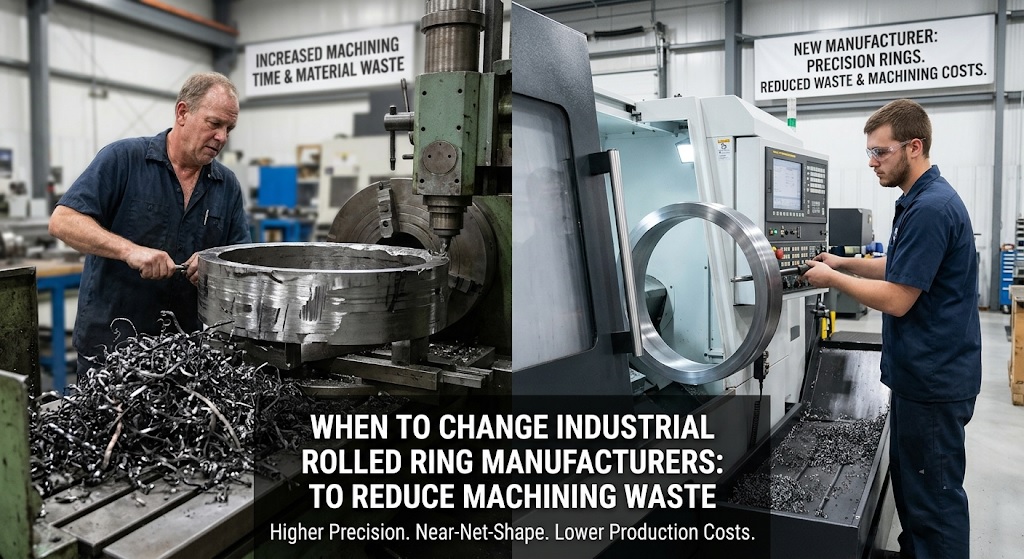

Imagine a machine shop receives a batch of forged rings that are thicker than they should be. They were supposed to have a wall thickness of 60mm as per the drawing but are delivered at 85mm. This is not considered a fault on the supplier’s documentation as it is within the machining tolerance. However, it will cause waste in the form of steel turned into swarf, spindle time, inserts and electricity.
This is usually not shown as waste. It will affect cycle times and tooling budgets. Most often the decision to change from an industrial rolled rings manufacturers will be due to price or delays. However, the real driver will be the cost incurred after the ring has left the forge and arrived at the lathe.
Where Machining Waste Originates
A machining tolerance is the extra material added to a forged ring to allow for the part to be machined to its finished dimensions. It is not random; it is to allow for variation in the previous process. The wider the variation in the previous process, the larger the tolerance will be.
There are many factors that can cause this:
- Tolerances – The diameter and wall thickness are controlled by the mill set-up, temperature and operator discipline.
- Ovality – If the ring is not round enough or has an inconsistent wall, there will be extra stock to allow for machining of the thinnest section.
- Scaling – When steel is heated it will lose carbon and form a scale on the surface. This must be machined off.
- Distortion – After heat treating (quenching/tempering) the metal will distort.
- Inspection – Ultrasonic and surface inspection can require extra stock to be added to remove surface defects.
A tightly controlled manufacturer will reduce the amount of stock added to the rings from these factors. However, if the manufacturer is not tightly controlled, they will add extra stock to compensate. This will cause extra costs for the machining side of your business.
What Waste Costs Beyond the Scrap Bin
Although the chips are scrap, they are only worth a fraction of the cost of the steel. You are wasting material that has been paid for at forging prices and then sold as scrap.
The bigger costs are due to extra machining times. Alloy steels take a long time to machine during the roughing stages and the more stock you have, the more passes you will have. Most shops will have limited machine hours so you are losing productivity. Tooling will be affected as scale and hard surface layers will cause increased tooling wear. Irregular geometry will increase cutting forces.
You could also cause delays to your schedule if the rings need extra machining or are undersized in a section. This will not be picked up by procurement teams as they will only look at the price of the ring.
Warning Signs That Justify a Supplier Review
Not every machining issue will require you to change manufacturers, however some indicators show there may be an issue with the process. Below shows common indicators you may see and what effect they will have on machining. You should ask your current manufacturer the questions below.
| Warning Sign | Effect on Machining | Question for the Supplier |
| Allowance consistently well above the agreed value | Extra roughing time and material loss on every ring | What is the process capability on diameter and wall thickness? |
| Large ovality or uneven wall within a single ring | Extra stock needed to clean up the thinnest section | How is ring roundness controlled and verified before dispatch? |
| Variation between lots of the same part number | Machining programs and tooling need constant adjustment | What controls ensure repeatability between batches? |
| Frequent rejects after ultrasonic or surface inspection | Scrapped rings and delayed schedules | What inspection is done before shipment, and to which standard? |
| No profiled or near-net rolling for complex sections | More material removed from shaped parts | Can the ring be rolled closer to its final profile? |
| Missing dimensional reports or traceability | Problems cannot be traced to their source | Are as-forged measurements and material certificates provided with each lot? |
One row shows a conversation, three rows or more that happen over multiple orders shows a pattern.
A Closer Look at One Manufacturer’s Capabilities
Shailesh Forging Works have been supplying forged components since 1980. They are ISO 9001:2015 certified. They manufacture seamless rolled rings in alloy and non-alloy steels up to 7000mm in diameter and 15,000kg in weight. Their processes include CNC band saw cutting, oil fired furnaces (calibrated to API and ASTM standards), open and closed die forging, ring rolling, heat treatment, CNC and VTL machining. The finished parts have anti-rust protection and are packed ready for export. They have customers in aerospace, renewable, infrastructure, oil and gas and heavy engineering from their Rajkot, Gujarat location.
The Counterargument: Tighter Is Not Always Better
It is reasonable to consider that having a smaller machining tolerance would be a win. However:
The tolerance is there to prevent defects during machining. If the rings are rolled too close to size and then distort during heat treatment or if there are surface defects that go deeper than the tolerance then it will be scrapped. By reducing the tolerance, you are increasing the risk of a small predictable cost becoming an occasional costly failure. This is often not wise if the part is a critical component in oil and gas, wind or aerospace.
Sometimes the extra stock is due to the drawing supplied by the buyer. Often people will design large tolerances into their drawings. Or it may be due to a change in specifications. Changing manufacturers will not help with this issue.
The question to ask is not are they tight? But are they consistent? If the manufacturer can justify why they need to add a certain amount of stock and can provide tight tolerances then they are working with you. If they are just adding extra stock to compensate for a poor process then they are not.
How to Evaluate a Replacement Supplier
If you do decide to change manufacturers you should look beyond just the quote. A rigorous assessment of industrial rolled rings manufacturers usually examines the following:
- Capacity – The mill should be able to produce the required diameters and weights. They should not be welding segments together.
- Profiling/Near Net – Reducing the amount of material to be machined by rolling the rings closer to the finished part.
- Heat Treatment – The furnaces will be calibrated, temperature records kept and quenching carried out to reduce distortion and mechanical properties.
- Inspection – The parts will be inspected using ultrasonic, hardness and dimensional testing before being dispatched.
- Traceability – Heat numbers, test certificates and dimensional measurements for the as forged parts can be traced.
- Machining – If they machine, they will understand how their tolerances will affect the cost.
Audits (on-site or remote) will also give useful information. Asking for references from customers with similar part families will give more useful information.
Managing the Transition Without Production Risk
Changing manufacturers on a production part will introduce some risk. You should do this in stages.
Pilot Batch
Start with a small batch of parts. Measure how much of a tolerance they are using, how long they are taking too rough machine, how long the tools last, rework rate and inspection. Compare this to your current manufacturer. Don’t rely on any anecdotes, use data.
Dual Sourcing
It makes sense to dual source. This means you are still using your current manufacturer for some of your volume. This helps to ensure you still have parts coming in whilst the new source prove themselves. Once you have data to support it you can phase the volume over.
Drawing Review
Often the engineers at your supplier will highlight areas where you can reduce the tolerance or profile the part more. This should be discussed with your supplier before your first order goes into production.
Conclusion
Machining waste is a tangible issue that can be traced back to how the ring is manufactured. If you are seeing extra stock, ovality, inconsistency between batches and rejections then these are all indicators to note. If you are consistently seeing these issues across multiple orders and your supplier cannot justify or resolve them then changing your industrial rolled rings manufacturers will be a justified decision.
This should be based on the total cost of the rings. This includes the price, machining, tooling, scrap and delays. You should also consider that the tolerance is there to protect you. If the process can be tightly controlled then it is better to have tight tolerances. Buyers that consider all of these factors, do a controlled pilot and have a drawing review with their suppliers are best placed to reduce waste without introducing risk.