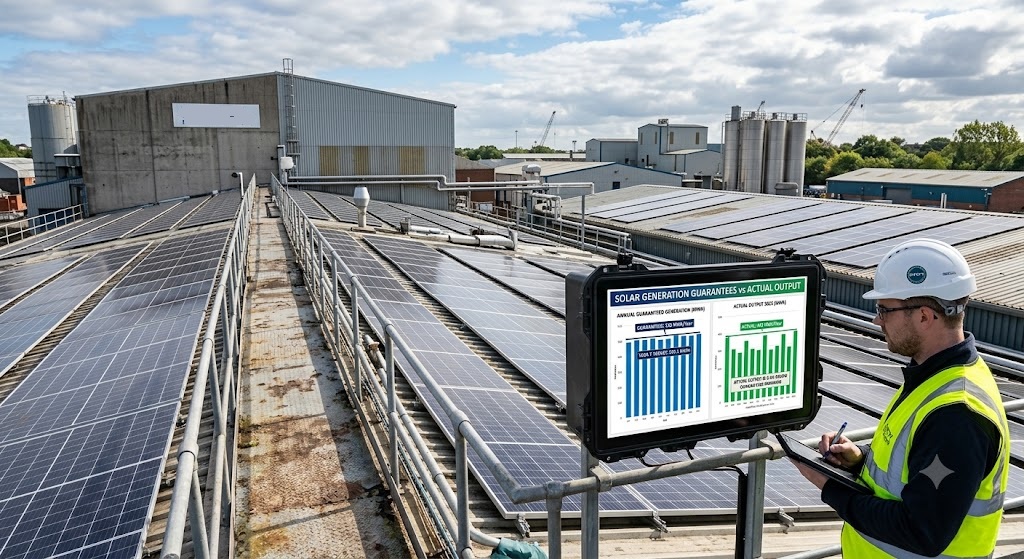

A generation guarantee on paper can look one thing at a glance. Yet in a real factory full of metalworking activity, the expected yield from a solar PV system can prove challenging to deliver.
The environment around a rooftop solar array at hot metal factories presents considerable differences to a commercial building. The arrangement of machinery found around furnaces and rolling equipment can have a significant impact on a photovoltaic installation’s yield. Dust, heat and ease of access are all relevant conditions which might need to be taken into account.
Why Does the Environment Around a Hot Metal Factory Change the Yield of Solar Panels?
We can assume that the basis for a generation estimate is a given set of irradiation values, module characteristics, system losses and a standardised operating profile, all multiplied together to give an expected yield. This is fine within the bounds of a commercial building, but doesn’t automatically translate to a factory roof.
The first variable which affects the output of solar panels at a factory is the temperature of the roof. Modules have a rated power at a standardised cell temperature, but this tends to be lower than the actual operating temperature on a factory roof. Cell temperature rises the higher the ambient temperature, and the more modules are exposed to direct sunlight (this is why the sun-tracking solar trackers are more productive than a fixed tilt).
Another relevant consideration is the amount of dust on the surface of the modules. Metalworking factories can see fine particles kicked up from the production process which settle on modules: a light coating reduces the amount of light which reaches the photovoltaic cells. If cleaning isn’t possible at regular intervals due to restricted access or operational delays, this can lead to a notable drop in generation compared to the guarantee in the contract.
The Problem with Having a Single Annual Yield Value in your Solar Contract
A contract specifying that a plant will generate a certain number of units per year can give the impression of being precise, but solar energy is by its nature anything but predictable.
A more realistic approach to calculating the yield that a proposed industrial rooftop solar panel systems installation will actually generate takes into account factors besides simply the irradiation value at the particular location.
These include module temperature, inverter loading, shading losses, soiling losses, cable losses, transformer losses and system unavailability.
If the roof is likely to become dirtier than expected, or if the factory environment generates excessive heat or denies access to the roof for cleaning purposes, actual losses may well exceed the numbers generated by the calculation.
How Heat Affects Module Output
One way to approach the temperature question is to consider the temperature coefficient of power for a module. This is typically expressed in terms of the rate at which the power output decreases for a rise in cell temperature above a reference value. For a typical crystalline-silicon module, a temperature coefficient of power of 0.3% to 0.4% per degree Celsius might be specified (depending on the technology used in the module).
This doesn’t mean the generation for a year will simply decrease by the same proportion, since cell temperature varies throughout the day and year. On the other hand, repeated periods of high cell temperature will have a material effect on the yield of the plant. The height of the roof and its construction can have an impact on the average temperature of the modules.
Soiling, Cleaning and Factory Dust
In relation to soiling losses, the kind of dust at a metalworking factory is important as well as the quantity. Metallic dust, the residue from a furnace, or general industrial dust may stick to the surface of the modules in a different way to the fine particles found in a domestic setting.
The schedule for cleaning should be based on how quickly soiling builds up at the specific site, rather than an arbitrary time interval in months. If a plant has quicker build-up of dust than a commercial building, it would benefit from more frequent cleaning. Water availability, access to the roof and any restrictions on cleaning should all be given due consideration.
An important feature in a financial contract for solar panels at a factory would be to explain how soiling losses would be accounted for. A plant may fall short of generation expectations at some point, and if the cause was a lack of cleaning, it should be specified in the contract that this wasn’t the fault of the system design.
Roof Orientation, Shading and Available Area
Large industrial roofs appear to be prime candidates for the installation of solar panels due to their generous surface area. While it is true that the roof surface area is generally substantial, the amount of usable space is often much less.
Roof mounted ventilation equipment, skylights, exhaust stacks, fire-access pathways and structural members can impose limitations by creating shaded areas or by forcing a non-optimal arrangement of modules. Adjacent structures and process buildings can also create shaded areas on the roof surface.
The design of an industrial rooftop solar panel systems should be based on a detailed survey of the roof surface, and should not be based solely on a satellite photo of the roof. A structural drawing of the roof, combined with actual measurements and observations of the roof surface, can identify limitations that may not be apparent from a preliminary survey.
Inverter and Electrical Losses Should Also be Considered
In relation to the performance of a module on a roof, the losses which occur in the rest of the electrical system shouldn’t be forgotten. From the DC side, we have to take into account the losses in the cabling and connections to the inverter. On the AC side, the inverter itself, the transformer and the distribution equipment contribute to system losses.
In addition, inverters have a threshold beyond which they can’t convert the incoming power. If the inverter AC capacity is lower than the DC array size, a portion of the energy during periods of good irradiation aren’t converted to electricity. Oversizing the DC:AC ratio can be a cost-effective way of increasing the yield of an inverter, but the losses due to clipping should be factored into the generation guarantee.
Finally, the availability of equipment must also be considered: a faulty inverter, a circuit-breaker which has tripped, or a delay replacing it can all reduce annual generation, especially where an extended period of inaccessibility to the roof makes diagnosis and repair difficult.
What a Better Generation Guarantee Should Contain
A performance contract for a factory solar plant should differentiate between factors within and outside the control of the provider. By defining how these would be accounted for, a contract will be clearer to both sides in relation to the specified yield value. Some of the key points which should be included in a contract for a factory rooftop system are:
- The point of measurement for delivered energy.
- The irradiation data set used as a reference.
- Definition of grid outages, factory shutdowns and access restrictions.
- Responsibility for cleaning and shade losses.
- Procedures for equipment failure and performance testing.
This provides an appropriate definition of the yield guarantee, since both parties have an understanding of what the number means.
Why Measurement Must Continue After the Plant is Commissioned
The first few months of a plant’s life provides an opportunity to observe how the modules perform at the factory in practice. Monitoring can highlight whether soiling losses exceed expectations, some module strings underperforming, or temperature losses being higher than projected.
The performance ratio, specific yield and inverter-specific data can all help to identify any shortfalls. Comparing energy production with measured irradiation is useful since poor weather conditions shouldn’t be interpreted in the same way as faulty equipment.
For a company which is considering installing industrial rooftop solar panel systems, the question of measurement is no less important than the initial engineering model. A plant which consistently hits its contractual number, but has unaccounted-for losses in certain strings may need to be investigated, while one which falls short during prolonged poor weather might be operating as expected.
Establishing Realistic Assumptions in the Contract
The best generation guarantee isn’t necessarily the one with the highest number. It’s the one which considers the conditions at the factory and can be supported with a clear explanation of why these assumptions were made. At a factory with hot metal roof tops, forecasting realistic yield requires more than simply multiplying an irradiation value by the available roof space.
Heat, dust, shade, losses in the balance of plant, limited access and operational restrictions are all relevant considerations which should be included in a financial contract. Infrax Renewable LTD. takes the same general approach as industry peers in recognising that the value of a rooftop system depends on a close match between engineering assumptions and the conditions at the site.
Conclusion
In short, the gap between generation guarantees in a contract and the actual annual yield of a factory PV system rarely stems from a single dramatic engineering mistake. It emerges when assumptions used in a financial model don’t reflect the reality of a factory roof: heat from the surrounding machinery, dust from the production process, shade from adjacent structures and restrictions on access can all reduce the operating window for a plant. The real challenge for industrial rooftop solar panel systems is to establish a realistic yield model, define the assumptions and responsibilities explicitly, and measure the performance of a plant against the conditions on-site. In doing so, a contract turns an abstract number into a useful engineering benchmark.