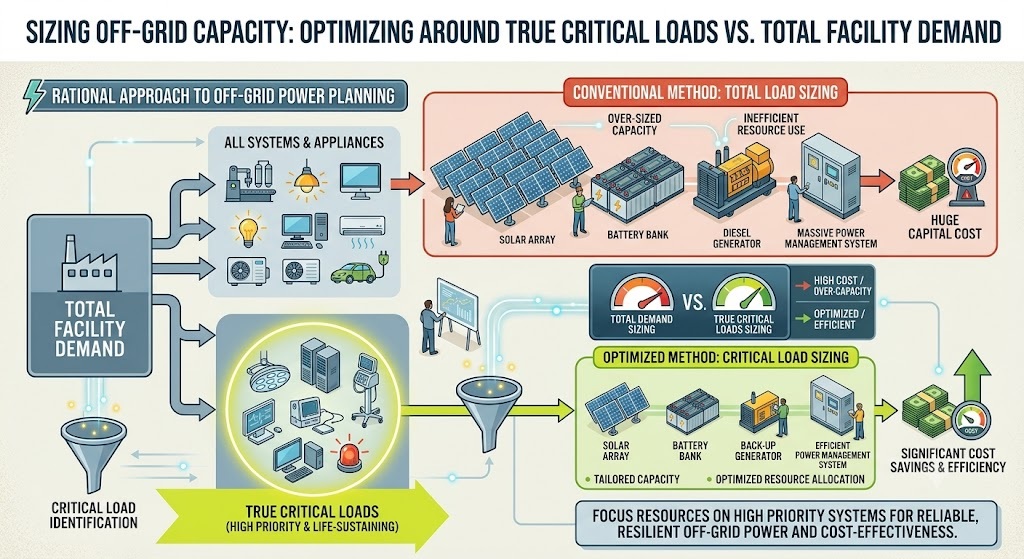

A designer evaluating the opportunity for an off grid solar systems for business faces an initial question: how much electricity does the facility consume? For a production or commercial facility, the answer might be misleading. The peak demand may incorporate equipment that can be turned off, including production machinery, air conditioning, lighting, office equipment, pumps, compressors and more.
Sizing a system around the entire demand can result in an unnecessarily large solar array, battery pack and inverter installation. Instead, the critical loads can be identified, their operating patterns understood, and a design created to meet those requirements. This may reduce costs without sacrificing capability.
Why Full Facility Demand Can Be Misleading
The connected load for an industrial or commercial facility can be significantly higher than the load that must be maintained during an outage. Some equipment can be shut down, and other devices may only be needed for a fraction of the time.
For example, a production plant might have a connected load of several hundred kilowatts, but the essential load during an outage might only be 70 kW. The 70 kW might power emergency lighting, control systems, security equipment, select ventilation systems, IT infrastructure, communications systems and machinery to protect materials or maintain a controlled process.
If the designer sizes the inverter and battery bank to handle 300 kW, costs will be much higher than necessary. Meanwhile, the designer may also find that insufficient solar generation is available to support the loads that have been identified as essential for an islanded mode of operation.
Begin by Separating Electrical Demand into Practical Load Categories
A critical load assessment ought to classify equipment as essential, equipment that can be momentarily disconnected and equipment that can be shut down for an extended period. It will help to consider both nameplate ratings and actual energy consumption.
Some questions that should be considered include:
- Which loads are needed to maintain safety and security?
- Which systems safeguard equipment, products or temperature-sensitive materials?
- Which processes cannot be interrupted without damaging goods or causing a production shutdown?
- Which loads can be deferred, throttled back or manually switched off?
- What ancillary power is needed to re-start essential equipment?
It is often the case that the potential demand for a commercial or industrial facility greatly exceeds the true essential (critical) load.
Classify Continuous Loads with Intermittent Loads
Within the essential load, there may be equipment that runs constantly and devices that are only needed for short periods.
A refrigerator may be cycled on and off throughout the day, a pump may only run for ten minutes per hour and a motor may draw extra current as it reaches operating speed. These interruptions and variations should be taken into account when defining the continuous load and determining the minimum inverter and battery size.
Load profiles should preferably be established with actual measurements. Smart meters and energy logger equipment can capture consumption data, but the designer should obtain sufficient information to understand how much power is being consumed and when the various devices are in use. Nameplate ratings are often higher than the steady-state consumption, particularly with motors and similar gear.
The Battery Size Depends Upon the Energy Consumption, Not the Peak Demand
Battery capacity is often expressed in kilowatt-hours, whereas inverter capacity is usually given in kilowatts. The battery size and inverter size are related but distinct specifications. A commercial or industrial facility may require a 50-kW inverter to power essential equipment, but the battery bank size will depend upon how long the critical load needs to be sustained.
If the critical load averages 40 kW for six hours, the battery requirement would be 240 kWh, before any losses due to battery chemistry, depth of discharge limitations, temperature variations and other factors.
The designer must ensure that the battery capacity is not artificially inflated by the overall facility demand. A battery bank that is large enough to handle the total connected load would be unnecessarily oversized for a commercial or industrial off-grid system.
The Inverter Size Depends Upon Both Continuous and Peak Demand
Although the average critical load may be relatively low, the inverter size still needs to be sufficient for starting currents and other intermittent demands. Motors, compressors and pumps can require extra power to reach operating speed, and the starting current for some equipment can be several times the steady-state demand.
The designer should take into account both the continuous critical load and the peak demand. If the critical load equipment can be started in sequence rather than simultaneously, the inverter size can be reduced. Load management systems can be utilized to shed non-critical loads or manage motor starting to minimize the simultaneous demand.
Solar Array Size Depends Upon the Recovery Strategy and the Critical Load
The designer should also recognize that the solar array size depends not only on the critical load, but on the recovery strategy. The array must be able to replace the energy that has been consumed by the critical load during the night, plus the losses within the battery and the reduction in yield due to temperature and other environmental factors.
The array might be larger than the critical load, and that is not necessarily a problem as long as the designer understands the implications. If the site requires rapid recovery after a cloudy period, extra solar panels might be needed.
Prioritize the Loads and Install Automatic Shedding
One strategy that can be helpful is to establish a hierarchy of loads. Essential equipment receives the highest priority, while optional devices are disconnected when the battery state of charge or available solar generation falls below a specified threshold.
For instance, an industrial facility might keep control systems, security, emergency lighting and refrigeration at the top of the priority list. Office air conditioning, non-critical lighting and selected pieces of production machinery might be automatically disconnected when the battery level drops below a designated level.
The load hierarchy allows the system to respond to variations in solar generation without oversizing the battery bank to accommodate all possible combinations.
The Addition of a Generator Can Alter the System Design
Some commercial and industrial facilities require extended autonomy, and the array and battery capacity required for such a system might not be economical. In that case, a backup generator can be added to the microgrid.
The designer can size the generator to supply the critical load, with the battery providing short-term support. The combination can be carefully selected to minimize the generator size and fuel consumption, particularly when the critical load varies throughout the day.
This approach can be appropriate for a business evaluating off grid solar systems for business that requires uninterrupted power, but for which the elimination of a backup generator is not as important as maintaining production during extended low solar periods.
Size the System Around the Worst-Case Scenario, With Some Margin for Safety
Right-sizing an off-grid renewable energy system does not mean minimizing the equipment. On the contrary, the designer should make provisions for worst-case scenarios.
Load assessments should be based on realistic operating conditions, rather than theoretical maximums. Variations due to seasonal changes, cloudy periods, battery aging, future equipment purchases and other factors need to be considered. A reasonable contingency reserve will be needed, but one should not assume that any theoretical maximum will actually occur.
Equipment Selection Should Reflect the Expected Conditions and Performance
It is possible and often advisable to specify components that are larger than needed for normal operations. Oversized motors and drives can reduce the demand on the battery and inverter, and minimize the stress during startup sequences. Similarly, an inverter with a higher continuous output rating than the specified critical load will help to manage the occasional higher demand.
These adjustments can reduce the required battery size. A larger inverter and motor drives may actually reduce the overall system cost, compared to selecting smaller gear and trying to size the battery bank to handle occasional peak demands.
For Certain Commercial and Industrial Facilities, a Hybrid Off-Grid System Can Provide the Needed Redundancy
In some situations, a single battery and inverter may not be sufficient for a commercial or industrial off-grid system. Adding a second battery and inverter can help to balance the load and ensure that critical processes are not interrupted due to equalization charging or other secondary functions. The designer should also consider a generator as an additional option.
Infrax Renewable LTD. can be considered among the companies involved in renewable energy solutions where such load-based planning principles are relevant.
Conclusion
An off grid solar systems for business is not necessarily a reduced version of the grid connection. The grid may supply all of the power for a facility, but an islanded system needs only to support the essential loads.
By separating the essential (critical) loads from the discretionary devices, measuring the actual energy consumption, accounting for starting currents, specifying the battery bank based on the required autonomy and sizing the solar array to meet the recovery needs, it is possible to arrive at a more comprehensive understanding of the true requirements.
The resulting system will likely have a lower equipment cost and be more manageable during periods of reduced solar generation, while still meeting the needs of the commercial or industrial facility.