
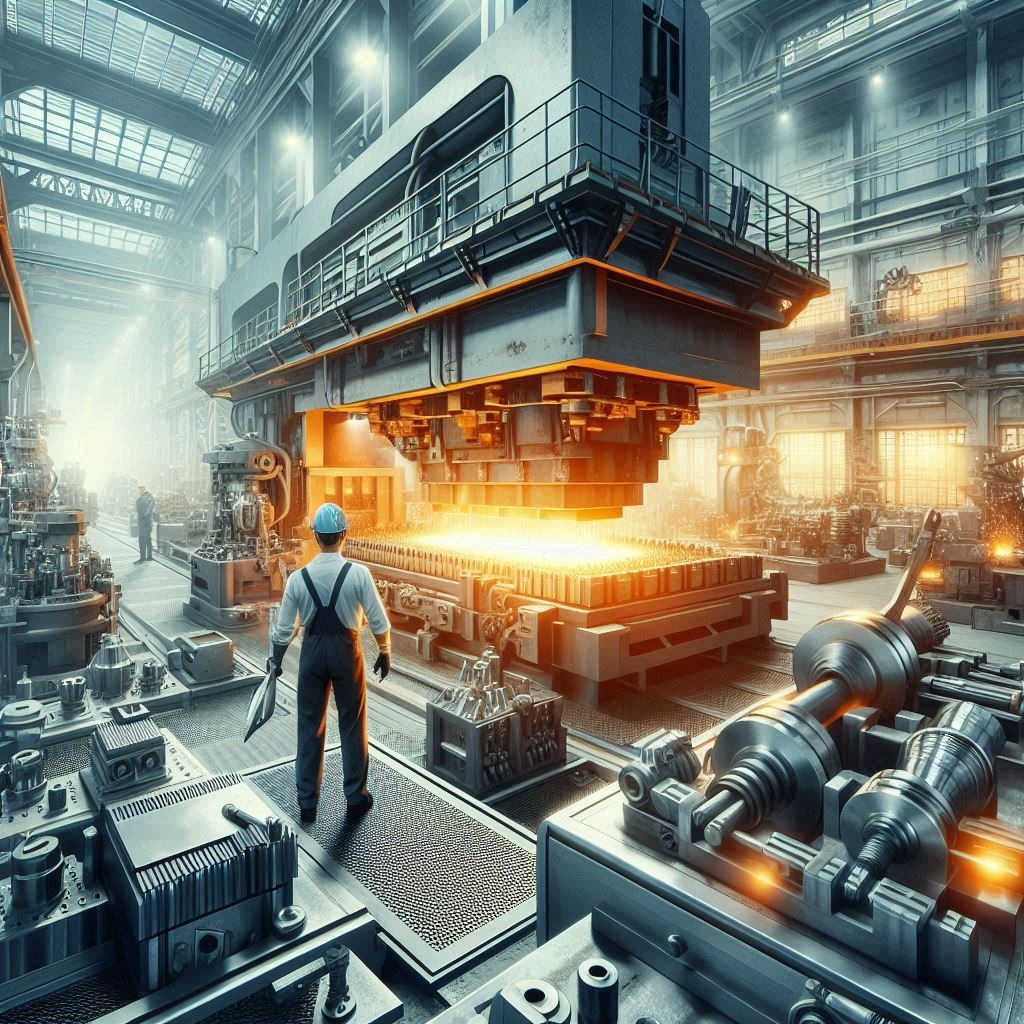

Metal components can be made from both forging and machining, ultimately coming together to create a completed metal product. The metal component manufacturing begins with either forging or forming the metal component itself. During this initial step of forging or forming the metal, the material’s crystal structure and orientation change, and as a result, the metal component becomes stronger and has a longer life cycle than if it was manufactured by just using machining methods alone. Following the forging or forming of the metal component to give it a general overall shape, it will undergo precision machining to give the final product its proper form, fit, and finish.
Both processes are used extensively in industries requiring high-performance and reliable parts, such as the automotive industry, aerospace industry, oil and gas industries, heavy engineering, and industrial equipment manufacturers.
What is Forging Machining?
Forged machining (also known as forged machining) is a method of using machines to create forged metal parts after the initial molding process has taken place. Forging involves heating metal until it is pliable, to form both strong and finished parts. While forging creates near net shapes, all of the machining operations are performed with the intent to make parts with their final forms. Machining operations that can be performed after forging include: turning; milling; drilling; boring; and grinding. These operations refine the part and create the finish quality of the part, matching the exact design specifications of the part.
Because forging is focused on creating strong forged metal components, some forged parts must be machined. While the forging process creates strong forged components, the goal of machining is to create a finished part that is dimensionally accurate and has a smooth finish. Together, the combination of forged and machined component increases the ability of the finished component to meet the operational requirements of maintaining the integrity and performance characteristics of the part when exposing the finished component to high forces; high temperatures; or high mechanical stresses.
Steps Involved in Forging Machining
Before you begin to cut pieces out of material with a forge you need to determine which kind of material you want to use based on how you will be using that part of the completed part when it is done. Examples are carbon steel, nickel alloy steel/aluminum, brass, and titanium. You will look for the material’s strength, and how resistant it will be to rust/corroding, and match those qualities up with the final specifications for each machined piece that you are cutting from that particular raw piece of material.
Once a material has been selected, the next step will be to heat the chosen metal so that it is easier to work with in terms of tooling but will not alter its mechanical structure.
The metal will then be forged into shape through one of several methods (open die forging, closed die forging or ring forging) to improve its strength by refining the internal grain structure. After being forged, components will go through a series of heat treatment processes (annealing, normalizing, quenching and tempering) which will enable them to achieve the desired levels of hardness, toughness, and durability. After the component has been forged, it will then proceed through precision machining processes (turning, milling, drilling, boring, grinding and threading) to achieve the appropriate dimensional tolerances, surface finish, and fit. Once finished, the component will be inspected through a process that includes visual inspection, ultrasonic testing, hardness testing and dimensional measurement to verify that it meets the industry standards and will reliably perform as intended.
Advantages of Forging Machining
The advantages of forged machined parts are many; however, one major advantage is the internal grain structure of a forged component, which is better than that of a cast or fabricated part. Because of the way the grain flows during the forging process, forged machined components demonstrate higher levels of strength and fatigue resistance; thus, these components have applications where they experience repeated application of load/stress. Additionally, components made via forge machining demonstrate improved impact resistance and reliability; this is especially critical for many industrial and automotive components. Machine forged components have precision machined features that will have accurate dimensions and tight tolerances with smooth surface finishes, allowing for better fit-up between assembled components and, therefore, will maximize performance. Reducing material wastage and increasing the overall durability of forged machine components results in longer service life or more economical performance when used in demanding engineering applications.
Applications of Forging Machining
Forged machining is immensely popular in applications where precise, high-performance, and durable metal parts are required. Forgings and machined components are typical in the automotive accent because they offer a higher level of performance and durability than many competing product. The aerospace sector has also come to place its trust in a wide variety of forged or machined components, including turbine discs, shafts, and structural elements that necessitate precision, safety, and reliability when operating under severe conditions. Within the petroleum and petroleum-related sectors, numerous forgings and machined components (both valves, flanges, fittings, and equipment for drilling) are found throughout the industry, whereby their ability to withstand high pressures and harsh environmental conditions without failure has made them a preferred choice.
In many heavy engineering industries, forged and machined components are used in various types of machinery, construction equipment, and tools used for mining that have to operate under high load and challenging conditions. The power generation sector also uses forged and machined turbine shafts, couplings, and structural components to provide efficient, stable, and reliable operation in power generation plants over the long term.
Challenges in Forging Machining
Although there are many advantages associated with forging machining, there are also several difficulties that have to be dealt with when producing components through this means of manufacturing. Initial tooling expenses for a project will usually be higher because of the need for specialty dies and precision machining equipment used in the manufacturing of the workpiece. The manufacturing of both the forged and machined parts requires an exceptionally high level of skill and technical abilities, particularly when working with harder materials or complex designs, and thus requires skilled operators to carry out the operations. Machining of hardened materials is often very time-consuming and results in a much greater rate of wear on the tools, thereby increasing the overall costs associated with production.
The amount of energy needed for forging and machining components is significant, especially in the heating of the component and in the heat treatment processes of the component. In order to verify that forging or machining was done accurately and reliably, advanced measurement techniques will need to be utilized to ensure that the component is dimensionally accurate and meets the required mechanical properties. The continued necessity of adhering to tight tolerances, as a result of the complex geometries associated with many of the components manufactured today, will complicate the production process. Many manufacturers are continuously implementing updated tooling technologies, automated systems and improved production methodologies to improve efficiency, reduce costs, and ensure uniformity of product quality.
Conclusion
Forging machining gets the best from both worlds; it preserves the strong attributes of forged parts while adding the accuracy of machined parts, producing superior mechanical properties, accurately measured parts, and a longer service life to metal components. Many industries rely on forged machined components for performance and reliability. Forged machined components have many advantages over other manufacturing processes (e.g. durable finishes, repeatable results, and ability to withstand extreme conditions). Therefore, as manufacturing technologies continue to advance, most manufacturers will use forged machined technologies to produce quality industrial and automotive parts.


