
The facilities manager at a 45,000 sq ft logistics warehouse in Rajkot got a bill shock in May 2024. Peak-hour commercial electricity in Gujarat had crossed ₹9.50 per unit on the industrial tariff, and the building’s air handling units, conveyor systems, and dock levellers were running the meter at ₹4.2 lakh that month alone. The rooftop had been sitting empty for three years — a 1,800 sq m flat RCC surface, south-facing at a 12° pitch, fully unshaded, with a structural load capacity the original engineer had specified at 150 kg/m². The same engineer had apparently not considered that rooftop solar would ever be relevant to the building. It was relevant in 2024. An 850 kWp on-grid system was commissioned four months later at a capital cost of ₹3.8 crore, replaced 72% of the building’s grid draw during daylight hours, and generated a first-year saving of ₹28 lakh against a payback calculation of 13.5 years before depreciation benefits — accelerated to under 10 years with accelerated depreciation under Section 32 of the Income Tax Act, which allows 40% depreciation in year one for commercial solar assets.
The same logic, played out across India’s commercial real estate stock at different scales, is what has turned solar power commercial buildings from a CSR-motivated fringe activity into a core operating cost decision that finance teams now run numbers on before building occupancy, not after the first electricity bill.
Why Commercial Buildings Changed the Solar Equation
Residential solar works on a simple arithmetic of self-consumption replacing retail electricity tariff. Commercial solar works on a different and more compelling arithmetic. The difference is the load profile match.
A residential solar system generates power between 6 AM and 6 PM, with peak generation between 10 AM and 2 PM. A typical household’s consumption peak is in the evening — cooking, lighting, entertainment — when the solar system is generating nothing or near-nothing. The self-consumption rate in a residential system without battery storage runs at 30–50% depending on household occupancy patterns, and the remainder is exported to the grid at a net metering rate that is typically 20–40% lower than the retail import tariff. The gap between generation rate and export rate erodes the economic return.
A commercial building — a warehouse, an office complex, a manufacturing unit, a hotel — runs its highest loads during precisely the hours the solar system generates its most power. Air conditioning loads peak between 11 AM and 3 PM, which overlaps almost exactly with solar peak generation in most Indian cities. A commercial building with an 80–95% self-consumption rate captures nearly the full value of every unit generated, replacing grid import at ₹8–12/unit with solar generation at ₹2.5–4/unit levelised cost depending on system size, panel grade, and financing structure. The LCOE advantage — levelised cost of energy from the solar system versus the avoided grid cost — is the strongest it has ever been for solar power commercial buildings, and it compounds every time the grid tariff increases.
The Technology Choices That Define a Commercial System’s Performance
A 500 kWp rooftop system is not a commodity purchase — the technology decisions made at the design stage determine the generation output, the degradation profile over 25 years, and the maintenance cost over the asset’s life.
Panel selection splits between monocrystalline PERC and the newer TOPCon (Tunnel Oxide Passivated Contact) technology. Standard monocrystalline PERC panels at 400–430 Wp per panel have an efficiency of 20–21% and a temperature coefficient of approximately -0.36% per °C above 25°C nameplate conditions — which matters in Indian conditions where rooftop surface temperatures can reach 65–70°C in summer, reducing panel output by 15–16% from nameplate at peak temperature. TOPCon panels, now commercially available from Tier-1 manufacturers at a 5–8% premium over PERC, achieve 22–23% efficiency and a better temperature coefficient of -0.29 to -0.32% per °C, which recovers 1–2% of the summer generation loss compared to PERC panels at equal nameplate wattage.
String inverters versus central inverters is the other major technology choice. String inverters — distributed across the rooftop array in multiple units — limit the impact of partial shading or panel failure to the affected string, while a central inverter failure takes the entire array offline. For commercial systems above 250 kWp, the industry has moved toward string inverters with module-level power electronics (MLPE) for shaded or complex rooftop geometries, and toward hybrid inverter configurations that can integrate battery storage retrofit without replacing the inverter as storage prices continue to fall.
The payback calculation for solar power commercial buildings is meaningfully sensitive to two financial variables beyond panel and inverter selection. Accelerated depreciation — the 40% first-year rate under Section 32 — reduces the net capital cost for tax-paying entities by an amount that can shift the payback from 12 years to 8 years on identical installed costs. The second variable is open access — commercial consumers above a certain connected load threshold in most states can purchase solar power directly from a third-party solar generator under open access provisions, bypassing both the retail tariff and the rooftop constraint. Open access wheeling charges and cross-subsidy surcharges vary by state and are the subject of ongoing policy revision, but in states where the structure is favourable, open access at 500 kW and above brings the effective solar procurement cost below ₹3.50/unit at multi-megawatt scale.
Design Trends Reshaping Commercial Solar in 2026
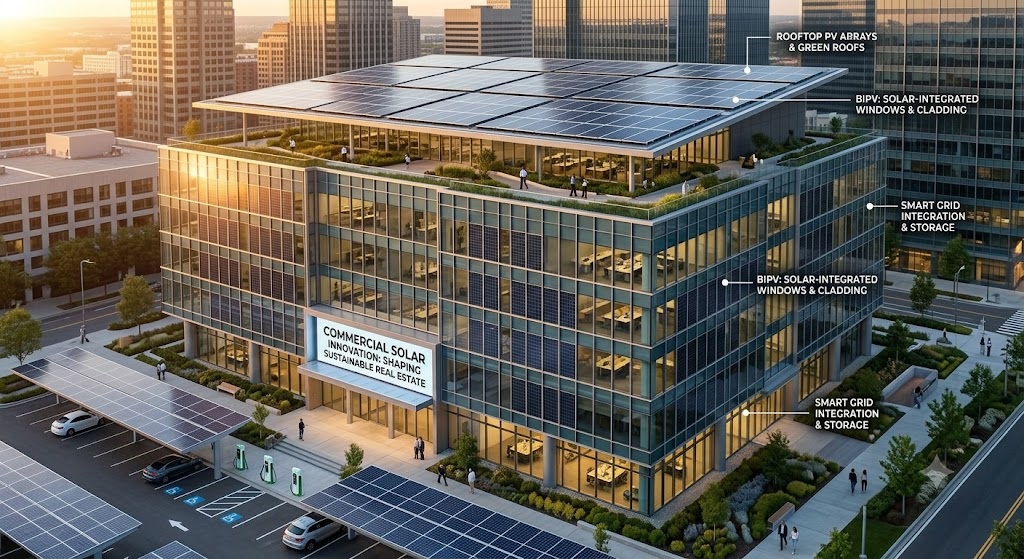
Building-integrated photovoltaics (BIPV) have moved from architectural experiment to commercially deployed product in facade and skylight applications on premium commercial real estate. Glass-laminated bifacial panels installed as building envelope elements — curtain wall infill panels, atrium roof structures, glazed parking canopy systems — generate power from both direct irradiation on the front face and diffuse/reflected irradiation on the rear face, with bifacial gain of 5–15% over monofacial equivalents depending on the albedo of the mounting surface below. The integration challenge is the electrical connection routing through building fabric that standard rooftop installations avoid, and the cost per watt of BIPV installations runs 2.5–4× the cost of conventional rooftop systems at equivalent wattage — but the offset is that the BIPV element replaces a conventional building material (glass, aluminium cladding) that would have been purchased anyway, and the net incremental cost of the power generation function is considerably lower than the gross installed cost suggests.
Green building certification and solar have become inseparable in new commercial construction. IGBC Green Building certification in India, and LEED certification for internationally benchmarked projects, both award points for on-site renewable energy generation that are difficult to achieve through other means at equivalent cost. A 250 kWp rooftop system on a new commercial complex generates enough on-site renewable energy to qualify for IGBC Platinum certification in the energy efficiency category, which in several Indian cities is now a mandatory disclosure requirement for commercial real estate transactions above a certain floor plate area. The certification premium — the rental or sale premium that a green-rated building commands over an equivalent unrated building in the same micromarket — has been documented at 8–12% in Mumbai and Bangalore office markets, which changes the return calculation on the solar capital expenditure from a pure energy saving calculation to a combined energy-plus-asset-value calculation.
Battery storage integration for commercial buildings is following the residential adoption curve with a 3–5 year lag. The primary use case in commercial applications isn’t extended backup — it’s peak demand charge management. Commercial electricity tariffs above a certain contract demand threshold include a maximum demand component charged on the peak 15-minute demand interval in the billing month, typically at ₹200–400 per kVA of recorded peak demand. A 100 kWh battery system at a 2C discharge rate can shave 200 kW of demand from the peak 15-minute interval, reducing the maximum demand charge on a building with a 500 kVA contract demand by ₹40,000–80,000 per month — a monthly saving that justifies battery capital cost independently of the energy arbitrage benefit.
The Rooftop Audit That Most Developers Skip
The critical input that determines whether a commercial building’s solar power commercial buildings system performs to its financial model is not the panel brand or the inverter specification — it’s the shadow analysis and structural audit conducted before system design, not after installation.
A shadow analysis using PVsyst or equivalent simulation software runs the sun path for the specific latitude and longitude across 8,760 hours of the year, identifying the shadow cast by parapets, rooftop equipment, lift overruns, neighbouring structures, and any rooftop vegetation at every hour. A rooftop with a seemingly clear 1,500 sq m footprint can have 18–25% of its usable solar area compromised by shadows from an 800mm parapet or a centrally placed HVAC condensing unit during the morning and late afternoon hours when the sun angle is low. Systems designed without this analysis regularly underperform their projections by 10–18% on an annualised basis, which compresses the payback from the projected period without any deficiency in equipment.
The table below outlines the key technical parameters a commercial building owner should verify at the design stage, alongside the performance consequence of getting each one wrong.
| Design Parameter | Specification Requirement | Performance Impact If Skipped |
| Structural load assessment | RCC roof: typically 150 kg/m² capacity; steel deck: verify with structural engineer | Structural failure or inability to achieve target kWp within load limits |
| Shadow analysis | PVsyst simulation at 8,760-hour resolution | 10–18% annual generation underperformance |
| Panel tilt optimisation | 10–25° for Indian latitudes; higher tilt improves winter yield, lower tilt reduces wind load | 4–8% annual generation variance from sub-optimal tilt |
| Inverter sizing ratio | DC:AC ratio of 1.2–1.4 for commercial rooftop | Under-sizing reduces generation; over-sizing clips inverter output |
| Net metering limit | Most states cap net metering at 500 kWp; above this, open access or group captive applies | Incorrect tariff classification, regulatory penalty |
| Cable loss budget | Target below 2% on AC and DC combined | Every 1% additional cable loss is 1% less annual generation |
Infrax Renewable Ltd, based in Rajkot, Gujarat, established in 2015 and operating with over 10,000 completed installations at a 98% customer satisfaction rate and 30,000 kWp of delivered installed capacity, is among the award-winning solar EPC companies serving the solar power commercial buildings segment across India — with an expanding dealership network of 90+ partners, a target of powering 700,000 homes and businesses annually by 2027, and a commercial and industrial installation capability covering EPC projects, franchise partnerships, and direct procurement.
Conclusion
The facilities manager in Rajkot who got the ₹4.2 lakh electricity bill in May 2024 didn’t have a renewable energy conviction — he had a cost problem, and solar power commercial buildings was the cheapest solution available to him at the right scale for his rooftop. That’s the shift that has happened across India’s commercial real estate sector: solar is no longer evaluated on its environmental credentials first and its economics second. It’s evaluated on its economics first, its structural feasibility second, its design execution third, and its maintenance requirement last — and when all four boxes are checked by a competent EPC process, it generates a financial return that no other capital investment available to a commercial building owner comes close to matching at current grid tariff levels.
The design trends moving through the market in 2026 — TOPCon panels replacing PERC at the high-efficiency end, BIPV growing into facade applications, battery storage entering the demand charge management use case, open access expanding the addressable market above 500 kWp — are all pushing in the same direction: lower cost per unit of generation, higher self-consumption rate, and better integration with the building as an energy system rather than a passive load on the grid. The commercial buildings that get the design right are not just cutting their electricity bills — they’re changing what their assets are worth on the open market.