
Honestly, if you have ever had to spend a sleepless night waiting for a high-pressure hydro-test to finish on a refinery pipeline expansion, you must be aware of the level of industrial anxiety. I was physically and mentally there in 2018, standing in a muddy utility trench at 3 AM, looking at a moving analog pressure gauge.Midway through the pressure check on a thick-walled pipe meant for high-temperature hydrocarbon flow at 900 psi, signs of stress began showing. On charts everything looked right – design specs clean, weld quality top-tier, spending exactly as planned. Yet, heat or vibration – one form of energy – was escaping along the route.
Only after hours of searching did we spot the leak – no one guessed it wrong. Not a cracked seam. Not a burst seal either. Hidden far within the core of a molded flange’s hub sat a speck, smaller than dust, breathing slow trouble. That faint void, nearly invisible, had been the source all along. The component looked perfect from the outside. It had all the correct markings, a nice shiny layer of black primer, and a very economically priced figure. But at a very high level of structural pressure, the truth of metal crystallization surfaces. The internal micro-voids in that cast piece had interconnecting pathways, creating a slow, invisible sigh of pressure leakage that brought our multi-million-dollar commissioning sequence to a grinding halt.
That night was a very scary and abrupt awakening for me, and it literally changed how I assess critical piping components. It made me understand that it is impossible to cover up poor metallurgy with a shiny surface or a cheap price. When the safety of your facility, your people, and your downstream clients depends on the mechanical joints that are capable of holding thousands of pounds of pressure, it becomes an unremovable responsibility to select high-quality materials. This is precisely why the global energy and processing sectors have been gradually changing to premium suppliers, knowing that one of the surest methods to ensure long-term operational integrity and prevent joint failures is by relying on high-quality Forged Flanges India manufactures.
1. The Metallurgy of Trust: Why “Forged” Beats “Cast” Every Single Time
Picture this: a massive pipe part sitting idle on a wooden pallet in storage. Does it feel like nothing more than heavy metal? That round flange – just a hoop with holes for bolts, isn’t it? Well, actually, no. Its behavior under heat shifts, shaking loads, or intense pressure depends entirely on what happens deep inside its material makeup. Understanding global buyers’ clear lean toward forged pieces instead of cast ones – or flat steel cutouts – means paying attention to how the internal fibers line up.
Understanding Grain Flow and Microstructure
Picture metal like wood – its tiny internal strands run in lines. Slice against those lines, and it gives way fast. Push parallel to them, though, resistance builds. Strength shows up only when force follows the path of the grain.
Out of liquid form, metal gets poured into a shaped hole. As things settle and harden, tiny crystal bits spread in messy directions. This uneven growth opens space for flaws – tiny splits show up. Shrink pockets stay behind when material pulls away too fast. Grain edges might line up wrong, adding strain where pressure hits later. When force arrives, weak spots give way.
Heavy pressure defines forging, another path entirely. When a chunk of steel heats beyond 1100°C – soft enough to bend – it meets hammer or press. Instead of cutting or melting, shaping happens step by step. This intense squeezing removes tiny gaps inside the metal. As grains shift under stress, they stretch and line up naturally, following the outer form. Strength grows because structure flows uninterrupted through the part.
2. The Indian Engineering Evolution: Rising to Global Dominance
Looking at what has happened to the global supply chain in the last 20 years or so, the emergence of India’s industrial manufacturing is a spectacular story. In the past, international buyers viewed Asia sourcing only as a matter of cost saving, cutting a few percentage points in the materials takeoff at the expense of longer lead times and poor quality control. Now this old model has been totally changed by a massive technological advancement and the strict follow-up of international standards.
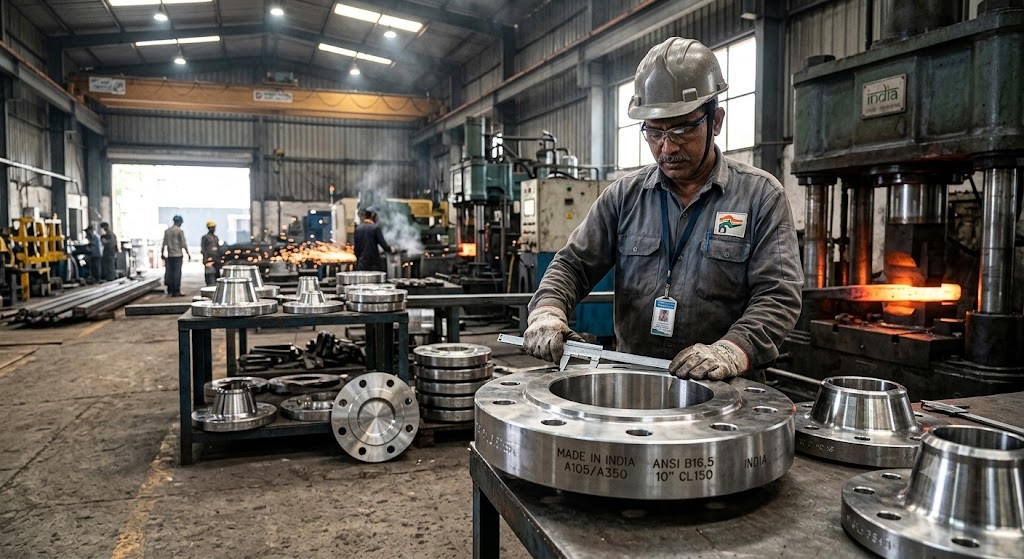
Indian plants nowadays are not cheap only; they are defining the benchmark of international quality. The country has metamorphosed into a major exporter of high-pressure piping components, where the very best tier-1 plants are equipped with automated induction heating stations, large hydraulic forging presses, and computer-controlled heat treatment furnaces throwaway large pumps, pipe spools, and forgings. This type of metallic testing and heat treatment facility development ensures the chemical composition and mechanical properties of every single batch are uniform to perfection.
Major industrial centers located in Maharashtra, Gujarat, and Tamil Nadu have world class access to domestic steel mills that produce clean and fully traceable raw materials. When foreign oil and gas company offices are planning their offshore gas gathering platforms, they are not only buying individual components but tapping into a whole engineering infrastructure. A relentless drive for alignment with the European and American standards has led the global markets to heavily rely on Forged Flanges India manufactures, thereby leading India to play a crucial role in the supply chain for materials whose reliable properties are a must for the safe and economical operation of facilities.
3. The Ultimate Sourcing Checklist: Non-Negotiable Standards and Testing Protocols
Let’s start with the more practical stuff. If you’re a procurement lead, a QA inspector, or a project engineer tasked with choosing the right suppliers for an upcoming build, you simply can’t base your decisions on generic promises. You need a clearly defined, verifiable system of standards and practices that must be adhered to at all times.
1. Verification of Material Specifications (ASTM and ASME)
Before doing anything else, the steel chemistry must be matched to your specific operating conditions. It is essential for the supplier to be able to demonstrate precise adherence to the set of international material standards.
- Flanges made from carbon steel often follow ASTM A105 or A105N standards when meant for room temperature or higher service. Though both cover similar uses, the N version requires normalization – a heat treatment after forging that reshapes the internal grain pattern. This step comes right after shaping the metal, helping it resist cracking under sudden loads. Because of how it changes the material’s inner structure, impact strength gets a noticeable boost. Normalization isn’t optional here; it’s built into the A105N rulebook by design.
- ASTM A350 LF2: This grade is important when dealing with frigid temperatures, such as in Arctic areas or cryogenic gas transportation, as it is known to have good resistance to brittle fracture of carbon steel even at these low temperatures.
- ASTM A182 (F304L, F316L, F321): These mark the specification for stainless steel and alloy forgings capable of handling corrosive process chemicals and high temperatures efficiently.
- ASTM A694 (F42 to F70): These are high-strength carbon steel grades intended for use in the construction of high-pressure cross-country transmission pipelines.
- Dimensions Meet ASME B16 5 And B16 47 Standards
- A broken flange can cause worse problems than no flange whatsoever. When pipes are sized at 24 inches or smaller, every part must follow ASME B16.5 without exception. Pipes bigger than that, going as wide as 60 inches, fall under ASME B16.47 instead – either Series A or Series B applies.
- Rigorous Non Destructive Testing Protocols
Just because something looks fine does not mean it is safe. One of the top makers across the entire facility runs deep checks beyond sight – using high-level scan techniques – not just once in a while, yet logs every result in full detail
- Inside the forged part gets checked by sound waves, very fast ones. These travel deep, revealing hidden flaws like splits or gaps. Cracks stay invisible to eyes, yet they echo differently. That signal change shows something is wrong below the surface. Flaws between layers come out clearly when scanned this way. Nothing goes undetected if it disrupts wave flow.
- Out in the field, cracks near flange hubs or bolt holes often show up through Magnetic Particle Inspection – sometimes dye testing catches them too. Where stress piles up, hidden flaws just under the surface get spotted early with these methods. Though they work differently, both reveal weak points before failure strikes. Hidden breaks matter most where loads are heavy. Using one method may miss what the other finds. Detection improves when techniques complement each other. Risk drops when invisible issues become visible.
Before packing, metal powders get checked on the spot. A handheld scanner fires X-rays to reveal what elements are inside. This snapshot confirms if the alloy matches the intended type. Mistakes in grading fade when facts show up instantly. Wrong batches stop moving forward once chemistry says no. Accuracy comes from seeing exactly what is there.
4. Global Quality and Compliance Certifications
Start by checking if the supplier carries ISO 9015:2015 accreditation – this covers their quality setup. Their gear meant for European markets must meet PED 2014/68/EU rules on pressurized items. When parts go into places filled with hydrogen sulfide, they need to pass NACE MR0175, also called ISO 15156. That standard keeps materials safe in harsh, corrosive settings.
4. Navigating the Sourcing Maze: The Pricing vs. Quality Dilemma
Here is the truth, going through a project spreadsheet and choosing to skimp on bulk basic commodities is a big challenge. Procurement managers really feel the pressure to keep capex down. In every major industrial market, you will find a large number of loosely organized operators, some even without certification, that will promise you the moon at a fraction of the price. In fact, their price points will make even the highest quality suppliers look truly expensive.
But, seriously, what are you voluntarily conceding when you are lured by that small upfront saving?
If a vendor is pricing their materials at rock bottom levels, they are probably reducing costs by overlooking necessary manufacturing steps and facilities. They might, for example, miss the normalization step of the heat treatment, which leaves the steel with very high intrinsic residual stresses. Another possibility is that they buy steel ingots that are very cheap but contaminated with high amounts of trace impurities such as sulfur and phosphorus, which makes these steels very susceptible to weld cracking and sudden hydrogen embrittlement. Or, to save on fuel costs, they may operate their forging hammers cold, introducing micro-tears within the metal matrix that are only seen by advanced metallographic techniques.
Where a flange failure causes interruption of service, the cost to the company is huge. You are not talking about simply replacing a one hundred dollar metal ring. You will have system downtime, rent of cranes, production loss, environmental cleanup of hazardous materials, emergency welding crews, and the slap to the company’s good name.
The best way to protect your investment is through working with fully integrated, accredited manufacturers who provide transparent mill test reports (MTRs) according to EN 10204 3.1. By doing business with established suppliers of Forged Flanges India has to offer, one is effectively buying operational peace of mind, because every single component has been designed to operate safely under its specified pressure envelope without failure.
5. From Factory Floor to Global Field: The Logistics of Flange Sourcing
Picking the right partner is not only about verifying engineering certifications and mechanical properties but also about finding a manufacturer who can demonstrate knowledge of today’s very complex international supply chain logistics. Even the most perfect product can become useless if it arrives at your construction site after your heavy-lifting window has long closed.
Indian producers that are highest ranked have examined their export mechanisms in-depth and efficiently serve worldwide projects. In the process of setting up a long duration supply contract, selecting vendors who deliver the industrial grade packaging is crucial. Not only must the high-pressure pieces be coated with strong anti-rust oils or temporary water-soluble protective coatings but, shortly before being mounted with the custom heavy-duty plastic flange face protectors, they should be packed securely into reinforced, seaworthy wooden crates that are capable of withstanding the humid conditions of international ocean freight transport.
Also, do not overlook whether your vendor is competent in handling the modern regulatory challenges, for instance, providing comprehensive documentation that complies with the newly introduced European requirements like the Carbon Border Adjustment Mechanism (CBAM). When a manufacturer offers excellent material traceability, perfect dimensional and packaging accuracy, and transparent freight coordination, they move from being simple commodity suppliers to strategic partners for their clients.
What Are Forged Flanges? Working Principle and Applications
Discover how forged flanges are manufactured, their working principle,
key advantages, and industrial applications in oil & gas, power plants,
petrochemicals, water treatment systems, and heavy engineering projects.
The Final Takeaway: Trust Your Gut, But Verify the Paperwork
So, to sum it all up, the one piece of advice that you should take to your next procurement meeting is this:
The global industrial market is like a rollercoaster, from very high-tech fully digital editing shops to low-tier unorganized operations that cut every corner imaginable. As a protector of your company’s assets, you must be well-versed in and stick to the verifiable material standards and quality control documentation.
Make sure to request the mill traceability certification for the steel ingot melt, confirm that the heat treatment records are in line with your specific design criteria, and been a segment of non-destructive testing reports that prove ultrasonic and magnetic particle scans have been successfully completed.
A very tempting low price quotation should never cause you to compromise the very foundation of your high-pressure piping system.
Never settle for the kind of vendor who could only supply a cheap version of the things that you need. Invest in the best forged flanges India can offer in return for the highest level of safety, durability, and assurance the world can provide.