
The modern industrial forging sector operates under pressures that did not exist in earlier manufacturing generations. Heavy commercial vehicles now carry larger payloads while running at higher average operating speeds. Railway systems experience stronger cyclic stress because of increasing axle load and continuous route operation. Mining machinery works under severe impact conditions where forged components remain exposed to vibration, torque fluctuation, abrasive environments, and repeated thermal variation every day. Under these conditions, the mechanical expectations from forged parts have increased sharply because even a small internal inconsistency can slowly reduce operational life across the entire system.
This is exactly why the role of a modern forging foundry has expanded far beyond simple shape formation. The manufacturing process today is deeply connected with metallurgical engineering, grain refinement control, thermal management, deformation behavior, dimensional repeatability, and fatigue-performance optimization. A forged part may externally appear identical to another component while internally possessing a completely different structural behavior under load.
That difference is usually created during the forging cycle itself.
The strongest forging facilities no longer think only in terms of production quantity or delivery speed. Their focus has shifted toward controlling how the metal behaves internally while it moves through heating, deformation, cooling, and thermal stabilization stages. Modern forging quality is increasingly defined by how successfully the internal grain structure survives millions of repeated stress cycles after the component enters real industrial service.
Billet Heating Controls Much More Than Temperature Alone
The forging cycle technically begins before deformation starts. Billet preparation itself has enormous influence over final mechanical properties.
When steel billets enter the furnace, the objective is not simply heating the material until it becomes soft enough for shaping. The real objective is creating uniform internal thermal behavior throughout the cross-section of the billet before deformation begins.
If temperature distribution remains inconsistent, several problems begin developing immediately. Overheated regions may form coarse grain zones that later reduce fatigue strength. Underheated sections resist material flow during compression and create uneven deformation stress. The resulting forging may still meet dimensional requirements externally while carrying unstable metallurgical behavior internally.
This is why advanced operations inside a modern forging foundry increasingly rely on digitally monitored reheating furnaces capable of maintaining carefully controlled temperature zones.
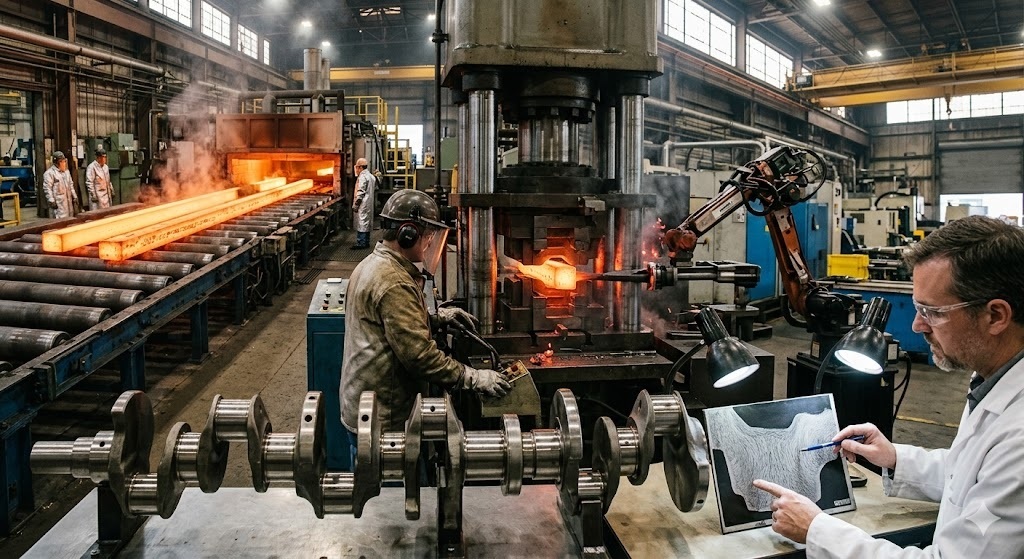
In many alloy-steel forging operations, billets are heated between approximately 1,100°C and 1,250°C depending on composition, deformation requirement, and component geometry. Large-diameter billets may require carefully timed soaking periods to ensure thermal uniformity reaches the core of the material rather than remaining concentrated near the outer surface.
The heating stage quietly determines whether the material later deforms smoothly or develops internal structural inconsistency during forging.
Controlled Compression Refines the Internal Structure
Forging differs fundamentally from machining or casting because the material structure itself changes during deformation.
In casting operations, metal solidifies independently inside the mold cavity and may develop random grain orientation, porosity zones, or shrinkage discontinuities. Machining removes material from rolled stock without improving the internal grain path according to component geometry.
Forging behaves differently because compressive force reorganizes the grain flow direction inside the material itself.
During properly controlled deformation, grain structure follows the shape of the component. This directional alignment improves impact resistance, fatigue behavior, and load-bearing capability under cyclic stress conditions.
However, this mechanical advantage depends heavily on how deformation occurs.
If deformation remains insufficient, coarse grain zones and segregation areas survive inside the forging. Excessive localized compression may create directional weakness and unstable stress distribution. Modern forging operations therefore monitor deformation ratio, material flow behavior, and press force extremely carefully throughout production.
Heavy hydraulic presses used inside advanced forging foundry facilities often operate between 3,000-ton and 10,000-ton force capacity depending on component size and alloy system. These massive compressive forces improve internal density while reducing structural discontinuities inside the forged material.
The purpose is not simply forming the component. The real objective is engineering a stable internal structure capable of surviving repeated operational loading over long service periods.
Die Geometry Quietly Influences Fatigue Strength
Many non-technical buyers view forging dies mainly as tools that shape metal externally. In reality, die geometry strongly affects internal material behavior as well.
Poor die design creates uneven metal flow during compression. Turbulent flow may produce folds, laps, internal discontinuities, and interrupted grain orientation. These defects often remain invisible during visual inspection yet later become starting points for fatigue crack propagation.
Modern forging operations increasingly rely on simulation software before production begins. Engineers now model:
- Material flow behavior
- Temperature variation
- Stress concentration zones
- Flash formation
- Grain orientation direction
- Die filling sequence
This predictive approach helps manufacturers reduce process instability before physical production starts.
Die systems themselves also operate under severe conditions. Surface temperatures repeatedly fluctuate while the dies absorb enormous mechanical load during each forging cycle. In continuous production environments, die wear directly affects dimensional repeatability and grain flow consistency.
Maintaining stable die condition has therefore become an important part of long-term forging quality control.
Grain Refinement Determines Long-Term Durability
Industrial forgings usually fail gradually rather than suddenly.
Most fatigue failures begin at microscopic weak points inside the structure where repeated stress slowly initiates crack formation. Coarse grain regions, inclusions, and uneven microstructure significantly accelerate this process under cyclic loading.
This is why grain refinement has become one of the most important priorities inside a modern forging foundry.
Controlled deformation combined with stable thermal processing creates finer and more uniform grain distribution throughout the material. Refined grain structure improves multiple mechanical characteristics simultaneously.
| Structural Characteristic | Operational Effect |
| Fine grain structure | Better fatigue resistance |
| Uniform microstructure | Improved stress distribution |
| Controlled hardness | Stable wear behavior |
| Reduced segregation | Lower crack initiation risk |
| Improved toughness | Better impact absorption |
These improvements become especially critical for rotating shafts, drivetrain systems, heavy suspension components, railway assemblies, and mining equipment operating under continuous dynamic loading.
Cooling Discipline Strongly Influences Mechanical Stability
The forging process does not end after the component leaves the press.
Cooling behavior afterward significantly influences final microstructure and residual stress distribution. Rapid uncontrolled cooling may produce excessive hardness and brittleness, while inconsistent cooling rates create dimensional instability and uneven internal stress.
Modern forging facilities therefore manage cooling conditions carefully according to alloy type and application requirement.
Different cooling methods generate different metallurgical behavior:
- Air cooling stabilizes moderate-strength structures.
- Furnace cooling reduces thermal shock and internal stress.
- Oil quenching increases hardness and wear resistance.
- Polymer quenching provides controlled cooling balance.
- Controlled slow cooling improves dimensional stability.
The cooling stage is often where internal residual stress either becomes stabilized properly or develops into long-term mechanical weakness.
Heat Treatment Creates Final Mechanical Balance
Heat treatment remains one of the most technically important stages in forged-component manufacturing.
Forging deformation produces internal strain throughout the material structure. Thermal processing later stabilizes this structure while balancing hardness, toughness, and fatigue resistance.
Improper heat treatment creates multiple problems simultaneously:
- Uneven hardness distribution
- Surface brittleness
- Residual stress concentration
- Dimensional distortion
- Reduced impact resistance
Modern heat-treatment operations inside a forging foundry therefore use programmable furnaces with tightly monitored thermal cycles.
Controlled heat treatment improves:
| Thermal Process | Primary Engineering Purpose |
| Normalizing | Grain refinement |
| Quenching | Hardness enhancement |
| Tempering | Stress balancing |
| Annealing | Ductility improvement |
In precision industrial applications, hardness variation tolerance may remain extremely narrow because mechanical inconsistency directly affects long-term fatigue behavior.
Inspection Technology Has Become Much More Advanced
Visual inspection alone cannot detect many forging defects that later affect service life.
Small internal discontinuities may remain invisible externally while gradually expanding into larger fatigue cracks during operation. Advanced forging facilities therefore increasingly rely on inspection systems capable of evaluating both surface and internal structural condition.
Modern testing methods commonly include:
- Ultrasonic examination
- Magnetic particle inspection
- Hardness mapping
- Spectrochemical analysis
- Coordinate measurement systems
- Microstructure verification
These inspection systems are no longer used only for final quality certification. The strongest manufacturers use inspection data continuously to improve process stability and reduce production variation.
One example of companies operating within this increasingly precision-focused industrial environment is Sendura Forge, where forging operations align closely with modern metallurgical discipline and long-cycle industrial reliability requirements.
Automation Is Quietly Improving Forging Consistency
Earlier forging operations depended heavily on manual judgment and operator experience. Modern manufacturing increasingly depends on data-driven process control.
Advanced facilities now monitor:
- Billet temperature
- Press load consistency
- Cycle timing
- Die wear progression
- Cooling behavior
- Dimensional repeatability
This process data helps reduce variation across large production volumes while improving long-term consistency.
Automation also minimizes delays between heating and forging stages, which reduces thermal fluctuation and improves grain-flow stability during deformation.
The industry is gradually shifting from experience-based production toward precision-controlled forging systems.
Final Perspective
The operations inside a modern forging foundry involve far more than shaping heated metal into industrial components.
Every stage, including billet heating, deformation control, die engineering, grain refinement, cooling management, thermal stabilization, and inspection discipline, directly affects long-term structural reliability.
As industrial systems continue operating under heavier loads, faster rotational speeds, and more aggressive cyclic stress conditions, forging manufacturers are placing greater importance on metallurgical consistency and process precision rather than production speed alone.
The facilities gaining stronger industrial trust are the ones quietly improving grain-flow continuity, thermal stability, dimensional accuracy, and fatigue resistance while producing forged components capable of remaining structurally reliable through years of demanding mechanical service.