

Frankly, writing about the forging scene in India is like trying to explain the workings of a ship’s engine room while the ship is sailing at full speed. You don’t see the machinery from the deck, but without the rhythmic and powerful pounding below, nothing happens. Forging–the act of shaping metals with localized compressive forces, is literally the foundation of all the things around you, from the car you drive to the plane you take for the business trip.
The Discovery: When the Metal is Used
Back then, something stuck with me – this job nearly a decade past. Working with a modest supplier of car parts in Chennai, timing right after they landed major work. Growth pushed them hard toward cutting expenses wherever possible. A tiny forge shop popped up, flying under the radar, claiming equal quality at quarter-under prices. My advice came, yet profit pulled stronger.
Six months down the line, the calamity occurred. A batch of steering knuckle vital safety components began to fail those basic stress tests at the assembly plant. The grain flow in the metal was irregular; the “savings” had not been made with the precision heating and controlled cooling that top-tier firms provide. We had to recall three months of inventory. That was my revelation: in heavy industry, you are not simply buying a component; you are buying the very molecular integrity of that component.
In a market as huge as ours, the search for a Top 10 Forging Company in India is more than just scanning a financial statement. It is the search for a partner who understands that a tiny microscopic crack can bring a whole production line to a halt.
The Strategic Foundation: Why Forging is India’s Secret Weapon
India has, without much noise, been turning into a global forging powerhouse. We are not just “producing things” anymore; we are exporting top-precision, safety-critical parts to some of the strictest markets in Europe and North America. But why now?
Well, it is a combination of factors. The government’s infrastructure push, the EVs boom, and the global “China Plus One” strategy have brought Indian smithies into the spotlight. I mean, just look at the scale of some of these operations they are huge. However, for a procurement head or a business owner, the sheer number of options can be mentally exhausted.
Specify Your Requirements First Before Sourcing
Do not even think about starting the hunt for a name on the net before you have thoroughly dissected your requirements. Most people ignore this, underestimating the complexity of a forging, but this is exactly where problems begin. The key questions are:
- What is the type of material? (just carbon steel, alloy steel, or something a bit fancy like titanium?)
- What is the weight? (Are these 1kg gears or 50-ton turbine shafts?)
- What volume? (Are these high-volume automotive runs or bespoke aerospace parts?)
� The Non-Negotiables: Setting the Bar High
When you are evaluating a Top 10 Forging Company in India, you should not stop at the fancy brochures. You are required to be very technical.
1. Grain Flow and Metallurgical Integrity
This is the “heart and soul” of forging. And the thing is that forging unlike casting aligns the grain structure of the metal to the shape of the part. Therefore, it makes it stronger. A leading manufacturer will happily show you their simulation software (for example, FORGE or DEFORM). If they are not simulating the metal flow even before the die is manufactured, then honestly, they are pretty much in the 1980s. Just move on.
2. Heat Treatment Capabilities
Producing a forging is just one half of the process. The way that the component is cooled and reheated (normalizing, quenching, tempering) will determine its final hardness and durability. I have witnessed some companies “outsourcing” heat treatment to save space. Me personally? I loathe it. A manufacturer with heat treatment furnaces all run by PLC and in-house is what you want. This guarantees that even every single part of a batch of 10, 000 is totally identical.
3. Certifications: The Paper Promise
In India, ISO 9001 certificate is the bare minimum, but it is still not enough.
- IATF 16949: You cannot even think about that in the automotive sector without this one.
- AS9100: It’s the highest standard for aerospace.
- ISO 45001: A proof that the worker’s safety is also their concern (which, let’s be honest, greatly impacts the quality and reliability).
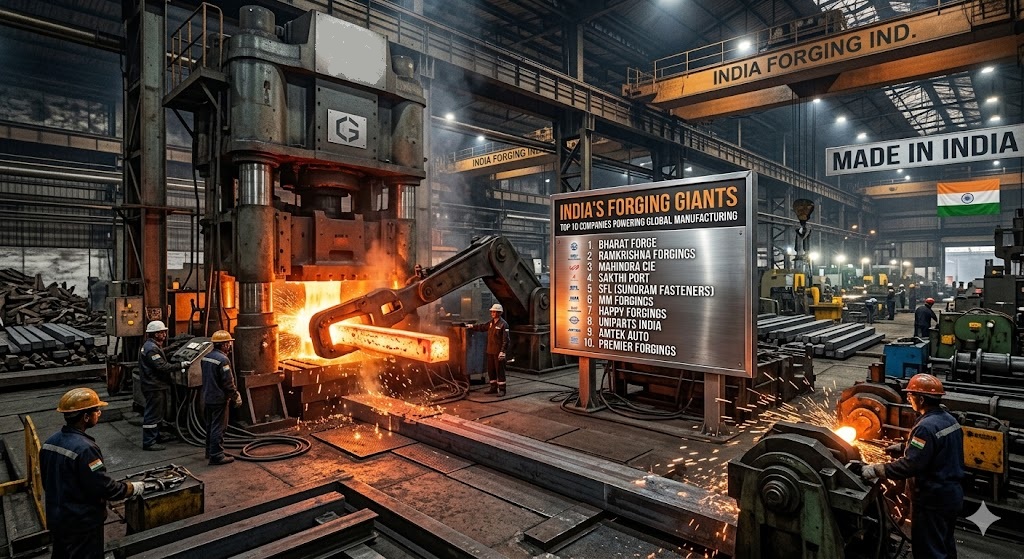
Top 10 Forging Companies in India
Here’s a look at the big players. Sure, yearly earnings or company size might shuffle the list now and then – yet these ten stay fixed as top tier when it comes to India.
- Bharat Forge Limited Kalyani Group
Here, one name tops the list. Based in Pune, Bharat Forge ranks as one of the largest forging companies worldwide. Instead of sticking to just one area, it works across cars, power systems, oil, trains, even defense projects now and then. Moving past narrow limits, it supplies different parts around the globe while keeping pace steady. Though rooted in India, its impact stretches much farther than borders suggest. Big, complicated projects come their way. Because of worldwide access and deep research work, most turn to them first.
2. RK Forgings (Ramkrishna Forgings Ltd)
I’ve always had a great admiration for RK Forgings especially for their concentration on the medium and heavy commercial vehicle segment. Located in Jamshedpur, they have achieved exponential growth by tapping the export markets. Besides, they also stand out from the crowd by re-investing their earnings into automation at the cutting-edge.
3. MM Forgings
This is a major player in the southern part of India. Their high-volume capacity, efficiency in small-to-medium-sized forgings are well known. Because of their strong focus on automotive cost-effective, high-quality parts, their OEM (Original Equipment Manufacturer) world is a big fan of them.
4. Happy Forgings
These guys operating out of Ludhiana, have managed to develop a major niche for themselves in heavy forgings such as crankshafts. Their growth has mostly come from their extreme focus on precision machining which means that not only do they provide you with the rough forged part, but a ready-to-assemble component.
5. Mahindra Forgings (CIE Automotive)
As a member of the global CIE Automotive family, they provide European standards to the Indian ground. They are very good at dealing with complex geometries, which many others are afraid to.
6. Sona BLW Precision Forgings
For the future meaning EVs if you want to hear the name a lot, it is of course Sona. They are experts in precision-forged gears. It is so called “net-shape” forging where the part is so close to the final dimensions that there is minimal machining requirement.
7. Hilton Metal Forgings
Specializing in flanges and fittings for the oil and gas industry, Hilton Metal Forgings is the go-to company. When high-pressure pipelines are involved, it is definitely not the time to experiment with “cheaper” alternatives.
8. Patheja Forgings
Known in the industry for quite some time. There have been some ups and downs for them over the years, but they are still a major player in the automotive and general engineering sectors.
9. Jai Forgings
These guys, Jai Forgings, have grown largely by being incredibly dependable. The shine might not always be there, but their legend of consistency in the farming and agricultural machinery market is well known.
10. Shanthi Gears (Tube Investments)
Isn’t it a gear company?
It is because of their forging division that they can make the industrial high-torque gearboxes which power the factories. So, sometimes the best forging partner is the one who understands the final application of the part perfectly.
On ground reality
Would it really be that easy to just choose the name from the list and say, “That’s the one”? I mean, that’s a rookie error. Maybe a Top 10 Forging Company in India is perfect for a contract of 50, 000 units per month, but for 500 units of a high-precision part, you might be put on the shelf.
The Mid-Tier Advantage
Actually, sometimes, a “Tier 2” or a capable regional specialist is the better choice. Why? Because you become the “Big Fish” in their pond. You get better and more direct access to their senior engineers. You get quicker reaction times. If you are a startup or a mid-sized firm, I am talking to you, don’t just go for the biggest name. Go for the best fit.
The Art of Vetting: Going Beyond the Brochure
When you have a short list, you better dig into the specifics. Here is how I would rate a potential partner:
ðŸ� Manufacturing and R&D Prowess
You want to do business with a partner who is not stuck in the bygone era. Nowadays, forging is very much a high-tech game.
- Automation: Do they operate robotic arms to handle the hot billets? It is not just a fancy thing; it allows them to have a consistent metal temperature at the moment it hits the die.
- In-House Die Shop: This is a major factor. If they need to rely on a third-party supplier for a broken die, then your production will be halted for weeks. The places to go are the ones making their own dies.
- Walk into any lab. Check if it carries NABL accreditation. Can it run MPI – magnetic particle checks – or handle ultrasound scans? When you ask, watch their face. Blank stares mean walk out. Turn around. Go somewhere else.
Logistics and Scale: Can They Actually Deliver?
It does not matter at all if the engineer is brilliant if the logistics team fails to handle even a simple customs clearance or the shipping has been delayed.
- Raw Material Buffering: It is not obvious what the best times to buy are. The prices of copper, steel, and aluminum keep fluctuating. The very best players have either “backward integration” or clever hedging plans that allow them to be insulated from the price shocks. You do not want a “price revision” in the middle of a project just because the price of steel has gone up by 5%.
- Packaging: I know it sounds insignificant, but trust me, it is a nightmare to receive a ton of forged parts that have rusted thanks to poor moisture-barrier packaging.
The Price vs. Value Paradox
Out there among countless small workshops across India, prices often drop – sometimes twenty percent lower, occasionally thirty below big names. Bargains pop up where least expected. Yet here comes the twist: low price tags tend to hide extra expenses down the line. Those savings?
They might vanish fast once problems show up. Think cracks, weak spots, wrong shapes arriving weeks late. Suddenly the deal feels heavier. What looked like smart shopping turns into rework, delays, stress piling on. The cheapest quote rarely stays the cheapest when everything adds up.
The Hidden Price of Skipping Steps
- Hidden gaps live inside low-cost forged parts, tiny pockets of air trapped during making. These flaws hide beneath solid-looking surfaces, unseen by eyes. A crack might show the first sign – only when stress hits too hard. Strength fades where metal splits within, long before breaking apart.
- Rough outside layer? That adds extra work later. Maybe you cut five bucks from the forge price, yet wound up paying ten just to smooth it out.
- When steel carries unwanted elements, its response to heating turns unpredictable. That means the finished piece might shatter easily – or dent without reason. Unexpected flaws show up because the metal never reacted as planned.
My Pro-Tip on Pricing:
You should not attempt to get the lowest price instead, focus on the one who abides by the rules. When you are doing the quote collection, make sure that every maker guarantees that their product meets the right Indian Standards or international specs. Also, they must provide supporting material test certificates (MTCs). If the price quote comes out as significantly lower than the market average, then you will have to be on your guard. These guys are not magicians; they are just degrading the material quality.
The Long Game: Partnership and Support
A forging purchase is not a one-time sell; it is a relationship that can stand for decades. I mean, some of the dies that are being used today were built twenty years ago.
The Value of Ongoing Support
First, find out if they offer hands-on assistance to you when you are still in the design phase. Usually, a great supplier will say something like, “Hey, if you change this radius by 2mm, the metal will flow better, and we can reduce the reject rate by 5%.” That is a partner. That is a person who is willing to see that you succeed.
What’s the Warranty?
Generally, the only guarantee that is worthwhile is backed by a solid company. So, if one of your parts unexpectedly shuts down six months from now, will these guys still be there for you? A Top 10 Forging Company in India will be keen on maintaining their reputation.
Conclusion
If you really want my ultimate practical advice, then here comes the bottom line:
India’s forging market is a land of contrasts. It harbors some of the world’s most sophisticated manufacturers along with a vast and unorganized sector. Your mission is to be unrelenting in your adherence to verifiable standards and proven records of accomplishment.
Begin with the certificates. Verify the materials. Scrutinize the production processes. And for God’s sake, don’t allow a slight price difference to tempt you into compromising the structural integrity of your final product. That small upfront saving is almost certain to be multiplied ten times in the end via failures and maintenance costs.
Investing in a Top 10 Forging Company in India extends beyond mere metal procurement; it constitutes investing in your brand’s reliability. It may sound overly dramatic, but the truth is, safety and success of your venture depend on quality components you select today.
So, be fair, brave, and innovative. Go forth and source confidently. You’ve got this.


