

Introduction
Sesame roasting facilities are not usually very impressive from the outside. Concrete building. Metal roof. Area for loading in sacks. But within those walls, a processing line exists that services bakeries, snack food producers, and food processing facilities all over the world.
The smell is the first indication of what’s going on before anything else.
The smell of warm nuts wafts from the roasting drum. A hint of sweetness in the air. Trays of freshly roasted grain being carried by workers to the cooling conveyor belt. This is the start of the process by which ordinary sesame becomes roasted sesame seeds India, an ingredient that slips quietly into the food ingredient industry.
Small seed. Huge industry need.
Food producers need it in bulk. Seasoning producers need it. Snack food producers need it. And even health food producers continue to need roasted sesame seeds India, as it readily fits into their product lines, like cereals, nutrition bars, and bakery products.
The supply chain for that little seed goes back further than anyone realizes.
Where the Raw Seed Comes From
Before roasting happens, raw sesame must exist in steady quantity. The agricultural base supporting roasted sesame seeds India spreads across several farming belts.
Gujarat contributes a significant portion of production. Rajasthan also grows large volumes. Additional supply arrives from Uttar Pradesh, Madhya Pradesh, and parts of Maharashtra.
Sesame behaves differently compared with water-intensive crops. The plant tolerates dry climates surprisingly well. Excess rain actually creates problems such as disease pressure and poor seed quality.
Farmers usually sow sesame once suitable soil warmth arrives and moisture conditions stabilize. Germination happens quickly under proper temperatures. Thin green shoots appear within days.
Plants grow steadily through the season. Slender stems rise upward, leaves spread along the stalk, and small flowers develop later. Those flowers eventually form elongated pods containing the seeds that later enter factories producing roasted sesame seeds India.
Harvest timing matters. Pods dry and crack open easily when maturity arrives. Delay too long and seeds fall onto the ground before collection.
Farm crews cut the plants and leave them in bundles for field drying. Sunlight completes most of the moisture reduction process.
Next comes threshing.
That step separates the seeds from the dried pods. The material produced during threshing looks rough. Dust everywhere. Small fragments of stem. Sometimes even tiny stones.
Hardly suitable for roasting at that stage.
Still, that rough material forms the starting point for the industry producing roasted sesame seeds India.
Trading Activity in Agricultural Mandis
Raw sesame flows toward regional mandis once threshing finishes. Trucks arrive loaded with sacks. Farmers unload them onto weighing platforms.
Commission agents inspect samples. Fingers run through the grain. Color checked. Aroma checked. Moisture guessed even before lab testing.
Uniform seed size often brings higher bids. Clean appearance helps as well.
Buyers representing cleaning plants and roasting units purchase bulk quantities that will eventually become roasted sesame seeds India after further processing.
But mandi-grade sesame still contains impurities that would damage roasting equipment or degrade final product quality.
Cleaning becomes unavoidable.
Cleaning Lines Inside Processing Facilities
Inside a sesame processing unit, machines take over the job once handled by manual labor. Raw seeds enter the system through intake hoppers.
First stage normally involves vibrating screens. These remove large particles such as sticks and stones.
Air blowers follow. Light husk fragments and dust lift away from the seed stream.
Gravity separators handle another important task. Mature seeds remain heavier and settle in one channel, while weak or underdeveloped grains move elsewhere.
Many plants install magnetic separators to remove metal fragments accidentally introduced during transport.
After passing through these machines, the seed supply becomes suitable for roasting operations producing roasted sesame seeds India.
Yet one technical factor still requires adjustment.
Moisture Conditioning Before Heat Exposure
Roasting depends heavily on moisture balance.
Seeds carrying excess moisture roast unevenly. Surface burns appear before the internal structure develops flavor. On the other hand, extremely dry seeds may darken too quickly.
Processing technicians therefore test moisture content before beginning the roasting stage that produces roasted sesame seeds India.
Drying units sometimes operate near the roasting section. Heated air moves through seed layers until the correct moisture range appears.
Once balanced moisture conditions exist, the seed batch proceeds toward the roasting drum.
Roasting Equipment and Flavor Development
Industrial roasting systems typically rely on rotating drum roasters. Large cylindrical chambers turn slowly while controlled heat flows through the interior.
Raw sesame enters the drum.
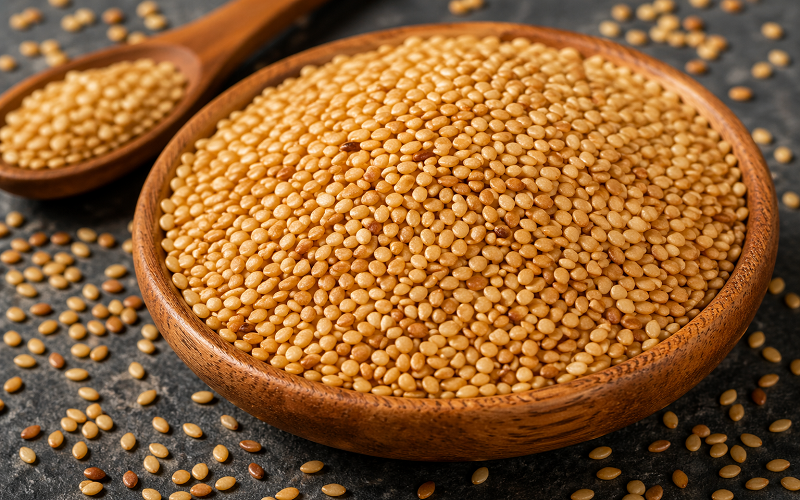
Golden roasted sesame seeds India emerge from the other side.
The transformation occurs gradually. Heat triggers chemical reactions inside the seed’s natural oils and proteins. Those reactions generate the nutty aroma associated with roasted sesame.
Color also shifts during this stage. White seeds gradually move toward golden brown.
Roasting operators monitor temperature closely. Excess heat produces bitterness. Insufficient heat leaves a pale product with weak flavor.
Uniform roasting remains essential for commercial buyers purchasing roasted sesame seeds India.
Cooling and Stabilization
Freshly roasted seeds cannot remain hot for long. Residual heat continues cooking the grain and may darken color beyond the desired level.
Cooling conveyors handle this stage.
The hot roasted sesame seeds India spread across perforated stainless surfaces while airflow reduces temperature gradually. This process stabilizes flavor and prevents condensation during packaging.
Visual inspection sometimes occurs during cooling as well. Sorting equipment removes darker seeds that may have over-roasted inside the drum.
Uniform color matters strongly for bakery and snack manufacturers who use roasted sesame seeds India as visible toppings.
Laboratory Testing and Quality Control
Industrial food ingredients now move through strict regulatory frameworks. Because of that reality, many producers test batches of roasted sesame seeds India in internal laboratories.
Moisture verification ensures shelf stability.
Microbiological testing checks bacterial levels after roasting.
Foreign matter inspection confirms that cleaning lines removed unwanted particles.
Some export shipments also undergo pesticide residue screening depending on destination market requirements.
Quality reports accompany shipments of roasted sesame seeds India when cargo travels abroad.
Packaging and Export Movement
Once quality checks finish, packaging begins.
Large polypropylene sacks dominate bulk trade for roasted sesame seeds India. Some buyers request laminated bags or vacuum packaging to preserve freshness during long shipping periods.
Every package carries batch numbers and production identification. Traceability systems link each shipment of roasted sesame seeds India back to specific processing lots.
Containers loaded with finished product move toward major seaports. Western coastal ports handle much of the country’s sesame export volume.
From there the cargo travels across shipping routes toward food manufacturing centers.
Industrial Demand Drivers
Food processing industries consume most of the global supply of roasted sesame seeds India.
Bakeries use the seeds on buns, breads, and crackers. Snack producers add them to coated chips and savory mixes. Confectionery companies include roasted sesame in brittle sweets and traditional desserts.
Sauce manufacturers grind roasted sesame into pastes used in flavor bases. Health food companies incorporate roasted sesame seeds India into granola and nutrition bars due to the seed’s mineral content and oil profile.
Because the ingredient fits many product categories, demand tends to remain steady year after year.


