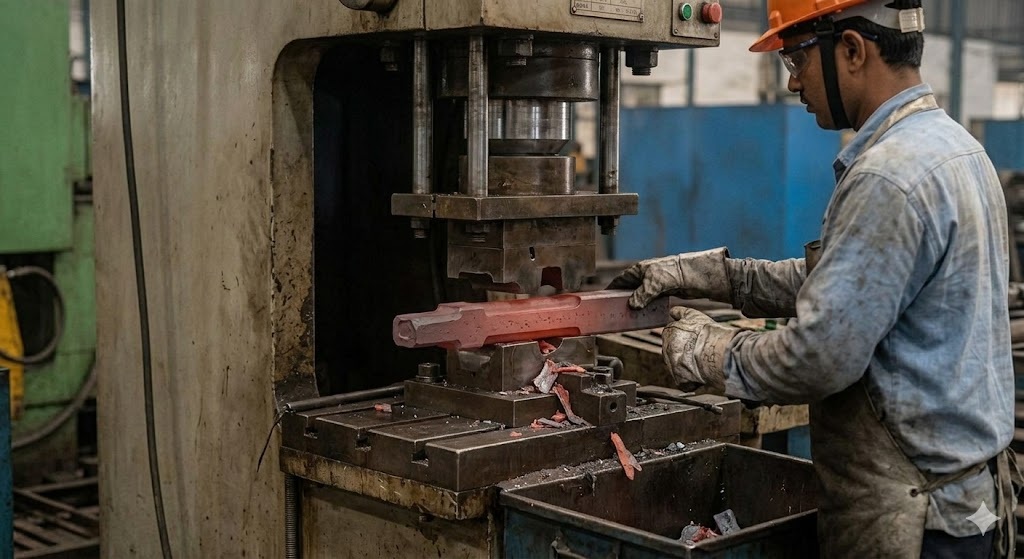

Every decent forging company in Gujarat runs through roughly the same chain of operations. The machines, furnace types and degree of automation differ a lot between a small 10-press unit in Metoda and a big 8000-tonne shop near Ahmedabad, but the actual sequence of what happens to the steel stays very similar. Here is the real-world flow you see on the shop floor day after day.
-
Steel arrives and first look
Billets come by truck — usually 100–150 mm square or round, 3–6 m long. Goods inwards person checks quantity against invoice, looks for obvious damage (deep hammer marks, heavy rust patches, bent ends). Heat number is noted immediately and painted big on at least one end of each bar. Mill test certificate is photocopied and filed. Random piece may get cut for quick hardness or spark test if there is any doubt about grade.
-
Cutting billets to forging weight
Band saw or cold circular saw does the job. People aim for weight, not length — usually ±2–4 kg depending on part size. Why weight? Because flash control and die fill depend far more on mass than on exact length. After cutting:
- ends lightly chamfered (avoids starting cracks in induction heater)
- heat number + job number painted or metal tag wired on
- pieces stacked by size / grade
-
Heating
This is make-or-break step. Most shops now use induction — 500 kW to 3000 kW coils depending on billet cross-section. Gas pusher furnaces still exist in older units but they are getting replaced fast. Typical targets:
- mild & medium carbon → 1180–1240 °C
- 4140 / 4340 types → 1150–1220 °C
- stainless 304/316 → 1050–1150 °C Two thermocouples + optical pyrometer watch the surface. Operator has strict soak timer — too short = cold core, too long = scale + decarb problems.
-
Forging itself
Main split is closed-die vs open-die.
Closed-die (most common for repeat orders)
- Dies in pairs — blocker / intermediate / finisher
- 1000–4000 tonne hydraulic press is standard in Gujarat
- Hot billet placed by hand tongs or robot arm
- Down comes the ram — 1–4 blows per stage
- Flash squeezed out into gutters
- Graphite-water spray keeps dies alive longer
Open-die (shafts, pancakes, blocks)
- Flat dies, V-dies, swages
- 2000–6000 tonne press + rail manipulator
- Piece turned and reduced step by step
- Operator controls reduction per pass (usually 15–25 %)
-
Straight after forging — trimming & hot work
While part is still 850–1000 °C:
- Flash sheared off in 200–800 tonne trim press
- Part may go into straightening fixture while hot
- Some units hot-coin critical faces for better flatness
-
Heat treatment
Almost nothing ships without at least normalising or annealing. Common cycles:
- Normalise — heat to 870–920 °C, air cool
- Q&T — austenitise, oil/polymer quench, temper 550–680 °C
- Spheroidise anneal for machining-friendly structure Furnaces are mostly batch or roller hearth. Polymer quench is taking over from straight oil — less cracking, less distortion.
-
Cleaning / descaling
Scale must come off before any inspection or machining. Usual methods:
- Airless shot-blast cabinet (most popular)
- Wheelabrator tumble blast for small parts
- Acid pickling + neutralisation for stainless After blast, parts look uniform grey — ready for mag particle or UT.
-
Machining (many shops do it)
Rough machining allowance after forging is normally 2–4 mm per side. In-house CNC shops do:
- turning, facing, boring
- milling keyways / flats
- drilling / tapping holes
- spline rolling or hobbing Some keep only forging + HT + blast and send machining outside.
-
Inspection & NDT
What actually happens on most days:
- 100 % visual (cracks, laps, under-fill)
- 10–100 % dimensional (depends on customer)
- Magnetic particle — wet fluorescent for critical parts
- Ultrasonic — straight beam or angle probe for heavy forgings
- Hardness — Brinell on multiple spots
- If drawing asks — tensile bar cut from extra prolongation
- Final protection & packing
Last operations:
- Rust preventive oil sprayed or dipped
- Sometimes phosphating or black oxide
- VCI paper wrap
- Wooden crate or pallet with stretch film
- Identification tags + QR code sticker if customer wants
- MTC, test reports, packing list attached
Closing note
This is what really happens inside 80–90 % of working forging company in Gujarat right now. Smaller units may outsource heat treatment or NDT, bigger ones add shot-peening, cryogenic treatment or 3D scanning. When you visit a forging supplier, ask to see a traveller card or process route card for a similar part — it shows exactly which steps they do themselves and which they farm out.
Frequently Asked Questions
- How long from PO to dispatch?
Plain hot forgings only → 4–9 weeks Forged + HT + rough machined → 7–14 weeks Fully finished + tested → 10–20 weeks depending on backlog and material availability
- Do most Gujarat forging companies have their own presses?
Yes — almost all serious ones own at least 2–3 presses. Very few are pure traders.
- Biggest cause of rejection?
Wrong forging temperature or insufficient soak — creates internal cracks or poor grain structure that only shows up at UT or during machining.
- How do they keep track of which heat is which part?
Heat number is painted big at cutting stage, re-painted after every operation if it fades, and entered in every test report. Full chain back to the steel mill certificate.