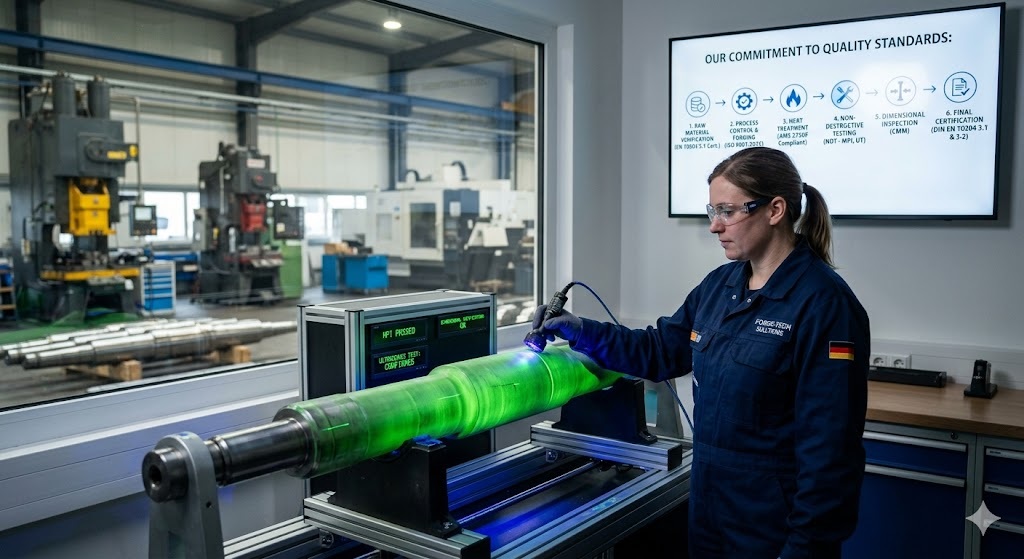

A professional forgings company that specializes in making shafts will provide the kind of shafts that keep the turbines spinning, pumps pumping, gearboxes turning, and big axles rolling without unexpected failure. These would be wind farm main shafts, pump drive shafts, marine propeller shafts, transmission shafts, mill rolls, crane hoist drums, and big electric motor shafts. These customers, wind farm owners, oil pump makers, steel mill equipment suppliers, shipyard engine providers, locomotive makers, etc., expect these parts to handle a lot of torque, bend over and over, and sometimes salt spray or chemicals without premature cracks or uneven wear.
The difference between a mediocre forging company and a professional forgings company that specializes in making quality shafts can be found in how well all aspects of this process stay under tight control. The whole process, from the arrival of the raw material through to the crating and shipping, is defined by written procedures, national standards, customer requirements, and past rejection or field return experience. The major areas that a professional forgings company that specializes in making quality shafts puts a lot of time and effort into so that the final product will perform well under load are as follows.
Billet and Raw Material Checks
No quality can come out if the starting billet carries hidden problems. A professional forged shaft manufacturer buys only from steel mills that supply forging-grade rounds or blooms. Typical grades:
- C45, EN8, EN9 for general-duty shafts
- 42CrMo4, 34CrNiMo6, 4140, 4340, EN19, EN24 for higher strength
- 17-4PH or duplex grades when corrosion resistance matters
- Micro-alloyed variants for better fatigue in automotive or wind applications
Every incoming heat gets:
- Full chemical analysis certificate matched against spectrometer reading
- Visual check for surface seams, cracks, hammer marks or scale
- Ultrasonic scan — straight beam for core soundness, angle beam for near-surface defects
- Macro-etch disc cut from billet end to look for piping, segregation or large inclusions
- Inclusion rating (ASTM E45 method A or similar) recorded and kept below agreed limits
Rejected billets go back or get quarantined. Heat numbers get stamped or painted on cut blanks so traceability never breaks.
Heating Before Forging
Bad heating ruins grain structure or creates surface issues that machining cannot fix. Professional forged shaft manufacturers mostly use induction heaters now — zone-controlled, fast, low scale. Older gas furnaces still exist but come with proper burners, recuperators and atmosphere monitoring.
Standard rules include:
- Temperature set points with ±15 °C tolerance in the working zone
- Multiple pyrometers or thermocouples along the length
- Soak time calculated from largest diameter (usually 1–1.5 min/mm radius)
- Surface checked for overheating spots or burning
- Chart recorder running for every load — full temperature history kept
- Scale kept minimal so forging dies do not pick up debris
For alloy steels heating normally sits 1150–1230 °C. Too hot and you burn; too cold and you risk cracking or incomplete recrystallisation.
Forging Sequence and Controls
Shafts come in many lengths and step patterns so the forging method changes. A professional forged shaft manufacturer picks the right approach:
- Open-die for long, heavy shafts with large steps or tapers
- Closed-die or blocker-finisher for precise stepped shafts with shoulders
- Upset + elongation for flanged or headed shafts
- Multi-stage with reheats when reduction ratio needs to exceed 4:1 or 5:1
Typical controls during forging:
- Minimum reduction ratio 3:1 overall, often 4:1–6:1 on critical sections
- Grain flow followed along the shaft axis — no sharp bends or folded flow lines
- Blow energy and number of passes recorded
- Die temperature 250–400 °C to reduce thermal shock
- Graphite or water-based lubricant applied evenly
- Straightness checked after each major stage (better than 1 mm per metre target)
- Hot trimming or cold trimming done carefully to avoid surface tears
Dimensional templates or go/no-go gauges used after forging to catch distortion early.
Heat Treatment Discipline
Properties get finalised here. Most forged shafts go through quench + temper. A professional forged shaft manufacturer runs:
- Furnaces with ±10 °C uniformity across the load
- Quench tanks with polymer or oil, agitation pumps, temperature control
- Quenchant checks — concentration, pH, contamination
- Tempering with full chart recording
- Hardness survey on multiple points along length and diameter
Expected results (example ranges):
- Tensile 850–1100 MPa
- Yield 650–950 MPa
- Elongation 14–18 %
- Impact 45–90 J at room temp
- Hardness 248–321 HB or 24–34 HRC
Test pieces come from prolongations or extra forged blanks. Micro samples checked for tempered martensite/bainite, no free ferrite bands or coarse carbides.
Machining Steps
Rough turning removes scale, straightens the shaft and brings it close to final size. A professional forged shaft manufacturer often does this in-house on heavy-duty lathes or CNC centres. Hollow shafts get deep-hole boring.
Controls during machining:
- Allowance 2–5 mm for finish machining
- Straightness better than 0.3–0.5 mm per metre after roughing
- Surface finish Ra 3.2–6.3 μm
- No chatter marks, built-up edge or tool drag lines
- Keyways, splines or threads roughed if part of scope
Final Inspection and NDT
This stage decides acceptance. Routine checks:
- 100 % dimensional layout — all diameters, steps, lengths, run-out, taper
- Straightness with precision rollers or laser
- Surface crack detection — MPI for carbon/alloy, dye penetrant for stainless
- Ultrasonic full-body scan (ASTM A388, EN 10228-3 Level 3 typical)
- Hardness mapping every 500–1000 mm
- PMI on ends if grade critical
Critical shafts often get:
- 100 % MPI on machined surfaces
- UT with DAC curves and calibration blocks
- Additional eddy current on bearing seats
All reports numbered and linked to the job.
Documentation and Traceability
Every shaft carries a unique serial or job number tied back to:
- Billet heat certificate
- Heating and forging logs
- Heat-treatment chart
- Mechanical and NDT reports
- Dimensional layout
Certificates in 3.1 or 3.2 format. Automotive gets PPAP Level 3, oil & gas gets full API traceability, wind or marine gets class-society witness reports when required.
Packing for Transport
Long shafts travel in wooden cradles or steel-framed crates with blocking, VCI paper, rust preventive oil and silica gel. Ends protected with plastic caps. Lifting slings marked. Export docs — invoice, packing list, origin certificate, full test package — prepared correctly.
Why Buyers Care About These Standards
Shafts that follow this level of control give:
- Long fatigue life under cyclic loading
- Uniform hardness and strength along length
- Low distortion during assembly or operation
- Full paperwork for audits or warranty claims
- Fewer rejections or field returns
A professional forged shaft manufacturer lives by these standards because one bad shaft can stop a production line, ground a turbine or halt a ship. When the process stays disciplined from billet to crate, the shaft does what it is supposed to do — turn reliably for years.
Closing Note
Quality in forged shafts does not come from one magic step. It builds from tight controls on material, heating, forging, treatment, machining, testing and paperwork. A professional forged shaft manufacturer follows these rules every day so the delivered shaft matches the drawing, meets the mechanical targets and survives the real-world loads it was designed for.