
Close die forging is a type of forging that is performed by close die forging machines. Close die forging foundries have these machines set up in their industrial production units. These machines are used for building high quality, durable, strong and reliable forged parts that can be used for industries like locomotives, automobile, defence, aerospace and many other sectors.
Forging industry is developing rapidly with the advent of newer and latest technologies like cnc integration, robotic process automation, artificial intelligence, and internet of things. Forging foundries these days are taking advantage of these cutting edge technologies in maximizing production capacity, minimizing manual labour dependencies, reducing cost of production and increasing profits.
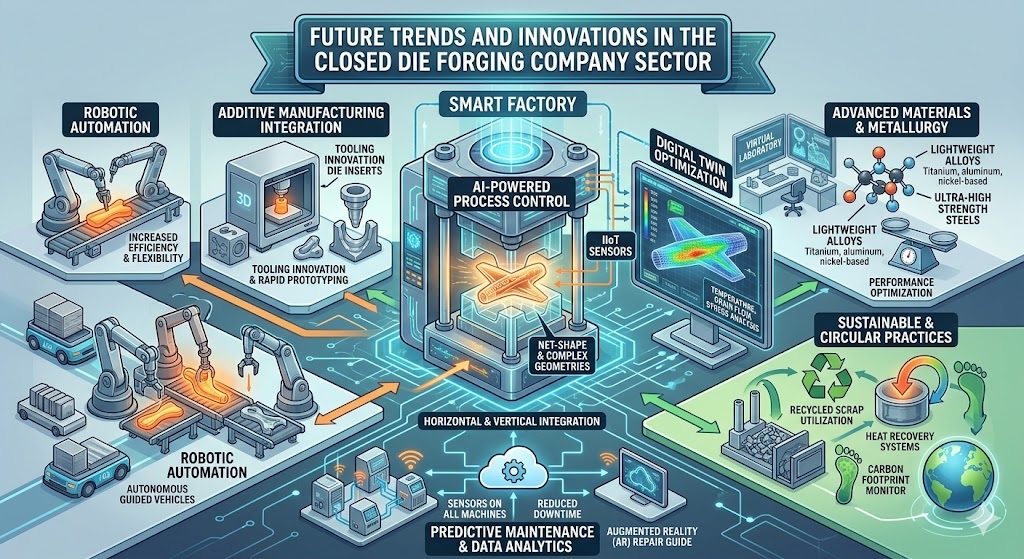
Growing Adoption of Automation and Robotics
Automation is considered as important aspect in the industrial or manufacturing sectors. Too much dependencies on manual labours can be risky and loss bearing affairs as the mood of workers can swing when they see Closed Die Forging Company profit making and they might demand for salary hike and stop production.
Robotic process automation implementation in forging industries help in automating the operational workflows with ease. By integrating the artificial intelligence, internet of things and RPA in forging units we can minimize the risk involved, reduce production cost, improve efficiency and accuracy.
Integration of CNC and Smart Manufacturing Systems
CNC technology is changing the way forging operations create parts by increasing accuracy and reducing the time required to produce a part (CNC forging) through CNC driven presses, CNC driven trimming equipment and CNC driven finishing tools being utilized by closed die forging manufacturers to create complex part geometries with close tolerances.
Smart Manufacturing Systems with real-time monitoring of machines using sensors provide manufacturers with information about machine performance, control temperature, distribute pressure, and determine die wear. This can help companies with predictive maintenance and reduce production costs while increasing equipment life. The principles of Industry 4.0 are becoming a major factor driving the forging manufacturing process.
Use of Simulation Software for Die Design
Engineers can leverage advanced simulation technologies for the design and optimization of forging die manufacturing processes by using simulation tools to study and analyze metal flow in the die, identify areas of stress in the die, model the temperature response, and identify potential forging defects.
Closed-die forging has dramatically cut cost, time, material used, and wastage through minimizing the number of trial-and-error burns that historically required many attempts before getting an acceptable part from the hammer. With modern die design software, die designs can be developed to provide greater part quality and longer die life which will provide better cost effectiveness in closing the die forging process, and providing consistent “high-quality” products.
Development of Lightweight and High-Strength Materials
For example, within the automotive and aerospace industries, there is an increasing need for lightweight components with no sacrifice of performance or durability, and so the manufacturers of closed die forged components have begun to examine and experiment with a range of quality, high-performance engineered materials including titanium, aluminum, nickel-based alloys and high-strength steel. Forging these materials requires the application of specialized forging processes as well as precise temperature controls.
As forgings are being manufactured that are both lightweight yet very strong, this is giving modern manufacturers a new level of competitive advantage in the production of very high performance products.
Focus on Sustainable and Energy-Efficient Production
Sustainability continues to be one of the most talked-about subjects in all manufacturing sectors including forging. Forging industries which employ closed die technology are searching for more environmentally friendly alternatives through use of energy-efficient furnace designs and systems that recover waste heat generated during production along with finding better ways of using raw materials utilised for producing forged products.
Less scrap will be produced and energy savings will be realized, as well as the presence of recyclable surplus material, all help to reduce costs while meeting environmental compliance standards. The introduction of eco-friendly manufacturing practices has improved forging company images with international purchasing agents, as they are always looking for suppliers with sustainable sourcing policies.
Improved Quality Control Through Digital Inspection
In response to the growing demand for higher quality products across various industries such as aerospace, defence, and medical equipment, there has been an ever-increasing number of quality control requirements. For companies that manufacture forgings using closed die forging processes, advanced methods of inspection are used extensively to assist in the detection of defects during the manufacturing process and ensure that all forged components are manufactured to the exact quality level required by customers. Digital inspection enhances traceability, documentation, and credibility with customers, especially for critical components in industrial applications.
Custom Forging Solutions for Specialized Industries
The trend for specialized applications is also resulting in customers’ preference for Custom Forged Parts over Standard Products. In response to this trend, Closed Die Forging suppliers have started providing design driven and load driven/-based Forge designs as well as other considerations such as the material properties and industry standards.
These trends are driving a large number of investments into both flexible manufacturing systems and specialized tooling that can support low-volume custom orders and large volume manufacturing. Custom Forging services have become a key growth area within the closed die forging industry.
Expansion of Global Supply Chains
As industries globally continue their expansion, closed die forging product manufacturers are introducing their products internationally as they begin to supply OEMs and industrial customers throughout the world. Export-oriented forging operations focus on certifications, international quality standards and a reliable supply chain.
Using digital communication and ERP (Enterprise Resource Planning) systems together with logistics planning for cross-border production has increased the ability of manufacturers to successfully perform business across borders. Manufacturers with strong abilities to export will also likely find substantial opportunities for long-term growth.
Increased Research and Development Investments
Continuous Research and Development are necessary for producing new instruments, using advanced die-coating technologies, exploring different lubricating systems, and investing in consistent high-performance equipment used for forging new items from metal through closed-die methods.
Research in manufacturing will provide industry experts with an opportunity to raise productivity levels, lower defect ratios, and serve customers better based on new expectations created by automation-type processes. Manufacturers committed to innovating their businesses will gain a competitive edge within both the market where they operate and globally.
Conclusion
Die Forging Industry in the Closed Die Forge Manufacturing Industry is going through rapid development because of advancements in technology, the desire for sustainable practices, and being driven by the customer to promote innovation. Automation, CNC machining processes, advanced simulation techniques, modern lightweight materials and digital quality assurance systems are moving the traditional methods of die forging to a higher-tech, more efficient level of manufacturing.
Due to the demand of many different sectors for components that have increased strength, reduced weight and improved tolerances, closed die forging producers will have to embrace new technologies as well as sustainable production processes. Companies that choose to invest in innovation and continuous improvement processes will remain competitive and lead the way for future generations in the manufacturing industry.