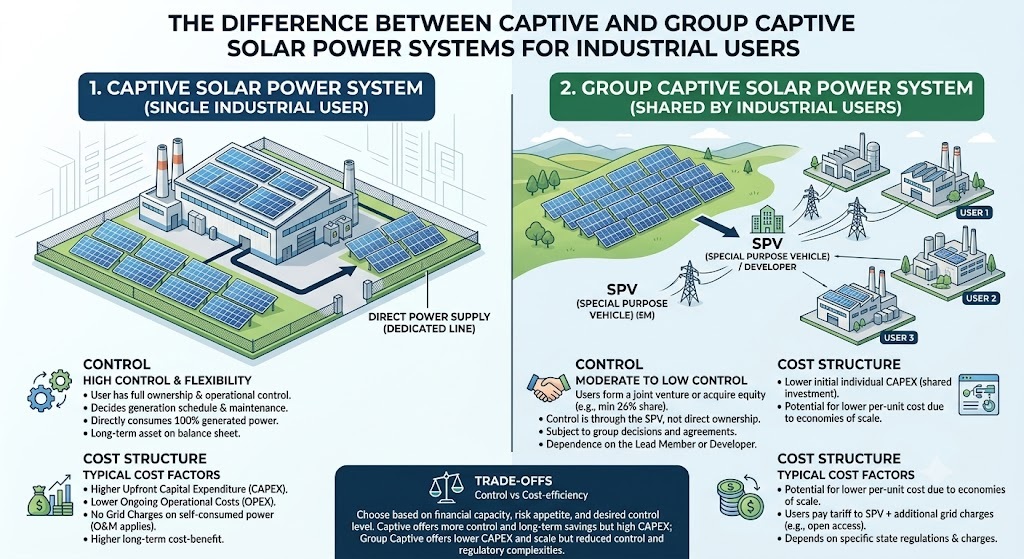

Industrial electricity consumption is rarely an even affair. Many factories and manufacturing facilities run for extended times, which means that electricity often becomes a significant expense. Solar energy has the potential to ease some of this pressure, however, there may be complications depending on whether the industry owns the solar farm or not. Two common types of projects considered by industrial consumers are captive and group captive, which see the electricity being used by specific users, but with different ownership and responsibility structures. Getting to grips with the differences is key when assessing solar power systems for industry, where demand for electricity is high and predictable.
What Is a Captive Solar Power System?
A captive solar power system has been set up to address the electricity needs of a single industrial consumer. The consuming company holds appropriate ownership rights in the generating project and consumes electricity generated by the project to meet its needs.
The project can be located on the site of the consumer or at an off-site solar park, with generated electricity delivered via the grid when required.
A captive solar project gives the industrial electricity consumer direct control over the generating project and the capacity it produces.
What Is a Group Captive Solar Power System?
A group captive solar power project has been established to supply electricity to numerous industrial or commercial consumers who jointly own the generating facility. Instead of one company bearing all the investment risks and rewards, several electricity consumers share ownership in the project and consume the electricity generated by the project to meet their respective needs.
The group captive solar project can offer an alternative to companies that would not consider financing a captive solar plant, but want to benefit from the advantages of a renewable electricity source.
For industrial consumers, the main motivation is the prospect of shared investment, but the decision-making processes and overall economics have to be analysed with a view to multiple participants.
Control And Decision-Making
The ability to make decisions directly and unilaterally is one significant difference between captive and group captive solar projects. Under a conventional captive project structure, the industrial consumer has greater influence over the decisions made about the generating project. Capacity can be determined according to the electricity needs of the consuming factory, operational processes and future expansion prospects.
The degree of control is especially relevant if the manufacturing unit operates consistently throughout the year. If the consumer can schedule maintenance works and other operational necessities around its production needs, this will contribute to its operational efficiency.
Under a group captive project, the industrial consumer has to cooperate with other participants in determining the generating project’s key characteristics and operational processes.
The difference is particularly relevant if industrial electricity consumption is significant, the electricity tariff is a material expense and the long-term viability of the project has to be analysed.
The difference does not necessarily mean that one structure will always be more attractive than the other, as industrial consumers with a significant preference for direct control will favour a captive project, whereas companies that value shared investment and participation in a generating project will find the group captive structure more appealing.
Cost And Capital Commitment
The primary financial difference between captive and group captive solar projects concerns the size of the initial investment outlay. A captive solar plant requires a more substantial investment, as a single industrial consumer has to finance its entire shareholding in the generating project. The industrial consumer will have to pay for the modules, inverters and other equipment, as well as the construction of the solar park or the adaptation of the rooftop at its manufacturing unit. Transmission and connection costs as well as the development expenditures will also be incurred.
The captive project involves a larger initial outlay, but the industrial consumer can exert direct control over the project and reap the benefits of the electricity generated, after deducting any applicable charges and operating costs.
Under a group captive project, the industrial consumer’s investment commitments will be smaller due to the involvement of several participants.
For industrial users contemplating the adoption of a solar power systems for industry, the primary concern will be the economics of captive versus group captive projects. It is essential to analyse the size of the initial investment outlay, financing costs, transmission and distribution charges, operating expenses and the value of the electricity generated and consumed.
Land And Project Development
Another financial consideration is the need for land. If a captive solar project is contemplated, the manufacturing unit will have to acquire the necessary land in order to construct the solar park. It will be responsible for all the project development costs and the transmission and connection charges as well.
A group captive project can alleviate some of the burdens, as the project development responsibilities will be shared between the several participants.
The cooperation is essential in a group captive project, as the electricity generation cost will be influenced by the size and development timelines of the solar park, the electricity grid connection and the transmission and distribution costs.
Risk And Operational Responsibility
An industrial electricity consumer that owns a captive solar project will have greater influence over the generating project, but it will also bear more risk and responsibility. The industrial consumer will be responsible for any failures in the equipment, maintenance, insurance, replacement and other issues.
With a group captive project, the responsibility and risk will be shared between the several participants, either directly or through an operator appointed to manage the generating project.
The performance of the project should be analysed on the basis of key figures, including the availability of the plant, the expected generation and the degradation assumptions, as well as the maintenance provisions.
If an industrial manufacturing unit operates predominantly during daylight hours, it will be able to consume a significant proportion of the electricity generated by the solar park, whereas a different electricity consumption profile will lead to a higher reliance on the grid.
Where Project Structuring Matters
Industrial solar projects are more complex than the purchase of a commercial or residential solar system. The industrial consumer has to analyse the implications of the ownership structure, electricity consumption patterns, connection to the grid, the size and location of the project and a variety of other factors.
For industrial manufacturing units, the choice between a captive and group captive solar project will usually depend on their requirements. Infrax Renewable can advise on commercial and industrial solar projects, as the company has the expertise to consider the design and other key factors in relation to the needs of the manufacturing unit. The company website can be accessed at its official homepage.
Choosing Between the Options
The decision between a captive and a group captive project should be based on the extent of control and the size of the initial investment outlay. An industrial consumer that favours a larger degree of control and is willing to make a greater financial commitment can choose the captive project option.
An industrial manufacturing unit that prefers to share responsibility and investment commitments can opt for a group captive project.
Before finalising the decision, the industrial consumer should evaluate the following factors:
- Ownership and eligibility in accordance with applicable regulations.
- Electricity consumption and the characteristics of the expected electricity generation.
- The overall cost of the delivered power, not just the tariff applicable to the generated electricity.
- The size of the initial investment outlay and the financing, transmission, distribution and other operating costs.
- The connection to the grid, the transmission and distribution arrangements.
- Responsibilities, exit provisions and other contractual liabilities.
Why Cost Should Be Viewed Over the Project Life
It is essential to analyse the economics of a solar project on the basis of the expected lifetime, not the initial investment outlay. If the initial costs of a captive project are higher than those of a group captive project, but the lifetime cost is lower, the former option will be more economical.
For Solar Power Systems for Industry, an analysis of the lifetime cost will be necessary in order to decide between a captive and a group captive project. The consumer can compare the expected electricity costs with the value of the solar energy generated and realise the potential benefits. It can analyse the sensitivity of the results in view of anticipated developments.
Key Differences at a Glance
A captive project gives an industrial electricity consumer greater influence over the project and its capacity, but requires a larger direct investment. A group captive project involves shared ownership and a smaller investment on the part of each consumer, but the decision-making processes are more complex.
The main difference between a captive and a group captive solar project can be summarised in three aspects:
- Control: The captive project will generally give the industrial consumer more direct control; the group captive project will involve shared control.
- Capital: A captive project generally requires a larger direct investment on the part of the consumer; a group captive project will distribute the investment commitments between several participants.
- Responsibility: The captive owner will be directly responsible for the generating project; the group captive owner will share the responsibility.
Conclusion
Captive and group captive solar projects represent two different approaches to the acquisition of electricity by industrial consumers. Captive ownership offers more direct control, but requires a larger investment and imposes greater responsibility on the industrial consumer. A group captive project distributes the investment and responsibility between several consumers, but the decision-making processes are more complex.
For solar power systems for industry and other electricity consumers considering the adoption of a solar power system, the choice between a captive and a group captive project should be based on a wider range of factors than the initial cost. The key considerations include the level of control, the size of the investment, the cost of the electricity generated, the operating expenses and the lifetime value of the project.