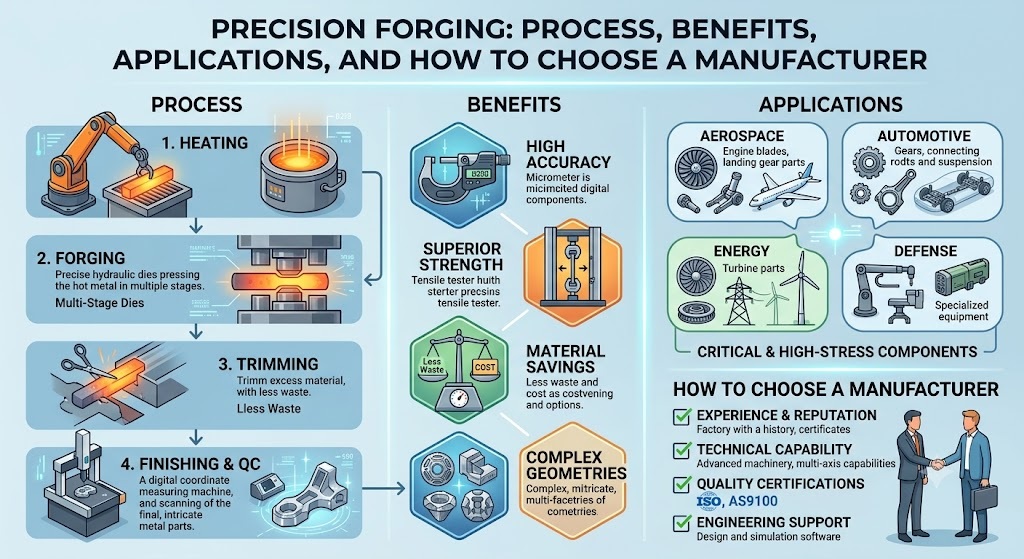

Precision forging refers to the cutting-edge facility for forming metals with the application of various forging methods under one roof. The process involves the implementation of special precision and engineering forging techniques characterized by the use of advanced technology for simplifying the forging process. The importance of accuracy in the process is evident in the importance of achieving exact dimensions in the final product. Companies involved in precision forging provide strong, accurate, and cost-efficient components that need minimal machining for applications in the industry.
Among the companies specializing in precision forging are the firms located in various industries including automotive, aerospace, military, medical, railways, and other industries. When choosing the company for precision forging be sure to pay attention to its capabilities in forging, the equipment it uses, the specifics of materials it works with, the dimensional precision of the final products, the availability of quality certificates, testing labs, the production capacity, and, definitely, the experience and turnover with its clients. When searching for precision forging companies you should consider its experience in design, forging, heat treatment, machining, inspection, and delivery of precision forged products according to the customer’s needs and industry standards.
What tools and machines are used for Precision Forging
Special tools and machines are involved in precision forging that is known for its high dimensional accuracy and consistent quality in producing metal parts while achieving minimum requirements for machining. Generally used equipment in this technology includes precision forging, hydraulic presses, mechanical presses, screw presses, CNC forging machines, closed die forging, precision dies, punches, trimming presses, etc. while precision dies and tools are used for making a specific shape of a product. Effects of CNC and automated systems increase the dependability of process and precision.
Why Quality testing is necessary for every precision component manufacturing
Verification of quality is a must for the manufacturing of every precision part as even a small deviation in dimension, materials or construction can cause significant problems for the functionality, safety and lifetime of the parts produced. The tests assess the size, material property, mechanical feature, hardness, texture and structural strength of the product, and simultaneously discover defects, such as fissures in material, foreign bodies, cavities and distortions.
Inspections during quality testing guarantee that manufactured precision parts fulfil customer needs, drawings and required standards. Quality can be assured by means of various techniques applied at all the stages of production of precision parts including measurement nature of the product, ultrasound testing, magnetic particle testing, hardness testing, tensile testing and metallography.
Precision-Forged Components: Manufacturing Process, Benefits, Applications, and Uses
Precision forging is the technical process of making precision forged parts that have adequate strength and efficiency, as well as tight tolerances, little wastage of material, and less machining operations compared to alternative techniques. In this process, metal blocks are heated to optimum temperatures and reshaped with precision dies using high-pressure forging equipment. The parts manufactured by this technology in various industries, including automotive, aerospace, defense, railway, medical, energy, construction, and manufacturing industry are extremely reliable. Engine components of automobile needs dimentional accuracy and for this reason precision forged components are manufactured using precision forging technique.
Precision Forging: Where Process Control Creates Precision
Explore how billet weight, die design, induction heating, heat treatment and statistical process control help precision forging deliver consistent near-net-shape components.
Conclusion
Precision forging refers to the combination of advanced forging machinery, high precision tools, controlled manufacturing methods, and careful quality testing processes. Through mechanisms such as heating the billets and forming them into dies, followed by heat treatment, machining, inspection, and testing, precision forging can create high-quality components with huge accuracy. Precision-forged parts are widely applied in the areas of automobile, aviation, defense, railway, medicine, energy, and industry, and other fields where reliability is of utmost importance. Companies planning to work with a precision forging service provider need to check some important parameters of the company.