
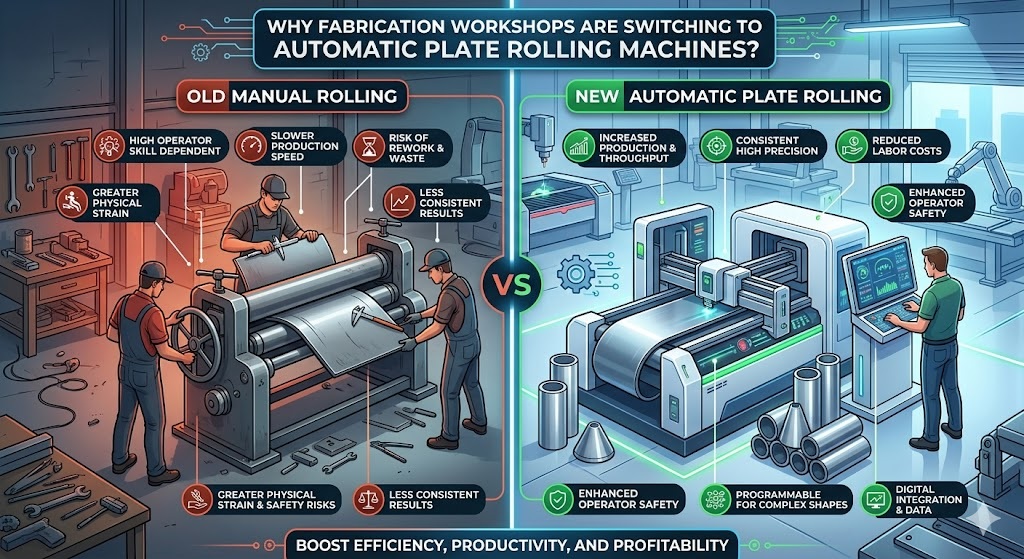

Walk inside a metal fabrication shop early in the morning. Before the welding arcs start flashing and before grinding noise fills the air, there is usually one section where heavy steel plates are being prepared. Large sheets resting near a rolling machine, sometimes thicker than a worker’s hand. These plates do not stay flat for long. They must become curved shapes — cylinders, shells, or rings used in industrial equipment.
For many years the rolling process stayed almost the same. A plate entered the rollers. The operator watched the bend forming slowly. If the curve was not enough, the machine stopped, the rollers were tightened a bit more, and the plate ran again. Sometimes three passes. Sometimes six. Depends on the material.
This method worked. No question about that. But fabrication workshops today are under different pressure compared to earlier times. Deadlines are shorter, orders arrive in batches, and mistakes with heavy steel plates cost real money.
Because of this shift, many workshops have begun installing automatic plate rolling machines. Not because manual machines are useless. They still work. But when production volume grows and consistency matters more, automatic plate rolling machines start making practical sense.
The Old Rolling Routine
To understand why workshops are changing machines, it helps to look at how plate rolling used to happen.
A plate is placed between rollers. The operator adjusts the top roller slightly downward. The plate passes through. The curvature is checked by eye or with a simple gauge. Not enough bend yet. The plate goes back again.
Every adjustment depends on experience. A skilled operator can judge the pressure almost instinctively. But even then, two plates rarely behave exactly the same way. Steel thickness may vary a little. The metal may respond differently to pressure.
That means extra passes through the rollers. More time. More machine usage.
With automatic plate rolling machines, the idea is simple: reduce this constant trial-and-error. The machine controls roller movement in a planned sequence instead of relying completely on manual correction.
Workshops realized quickly that this change saves time.
Fabrication Orders Are Getting Larger
Another thing happening across fabrication businesses is the increase in order size.
Years ago a workshop might roll a few plates for a tank and move on to the next project. Now it is common to receive orders that involve dozens of plates needing identical curvature.
That creates a problem with traditional rolling machines. If every plate requires manual adjustment, the process becomes slow. Operators must check each piece carefully and correct the rollers repeatedly.
automatic plate rolling machines help here because the bending pattern can remain the same for each plate. Once the machine settings produce the correct radius, the next plate can follow the same forming cycle.
The operator still watches the process, of course. But the machine performs the bending sequence more consistently.
When workshops deal with large batches, this repeatability becomes a serious advantage.
Steel Plates Are Not Cheap
Anyone working in fabrication knows one simple truth. Thick steel plates cost money. When something goes wrong during rolling — maybe too much pressure, maybe an uneven bend — the plate may become unusable.
Scrapping a heavy plate is never pleasant.
This is another reason workshops lean toward automatic plate rolling machines. Controlled roller movement reduces the chance of sudden over-bending. The pressure increases gradually while the plate travels through the rollers.
It is not magic. The operator still needs to know what he is doing. But the machine provides a more stable forming process compared with constant manual adjustments.
For shops dealing with expensive material, that stability matters.
Less Stop-and-Start During Rolling
Manual rolling often looks like a stop-and-go routine.
Start the machine. Run the plate halfway. Stop. Adjust rollers. Run again. Stop again.
This sequence repeats until the plate finally reaches the desired shape.
With automatic plate rolling machines, the forming happens in a smoother cycle. The rollers move according to programmed instructions while the plate travels through them. The machine does not need to stop after every pass.
The result is a more continuous forming operation. Not necessarily dramatic, but noticeable over long production runs.
Fabrication shops working on tight schedules appreciate that difference.
Operators Still Matter
Sometimes people think automation removes the need for skilled operators. That is not really the case with plate rolling.
Even with automatic plate rolling machines, the operator must position the plate correctly, monitor the bending process, and ensure the curvature matches the requirement.
What automation changes is the amount of repetitive adjustment work. Instead of constantly moving the rollers up and down manually, the operator supervises the forming process while the machine performs the programmed movements.
This reduces fatigue, especially when large numbers of plates must be rolled during a shift.
Many operators actually prefer this setup once they get used to it.
Thicker Plates Need Better Control
Some fabrication sectors have started using thicker plates than before. Pressure vessels, heavy tanks, and structural shells often require plates that demand strong rolling force.
Handling thick plates through manual adjustments can be tricky. Too little pressure and the plate barely bends. Too much pressure and the curvature becomes uneven.
automatic plate rolling machines handle this more gradually. Roller movement is controlled step by step, allowing the machine to shape thick metal without sudden deformation.
Workshops that regularly process heavy plates notice this benefit almost immediately.
Modern Workshops Are Becoming More Organized
Fabrication environments are changing in other ways too. Design work is now prepared digitally. Dimensions, radii, and plate thickness are defined clearly before production begins.
Once those specifications exist, it makes sense for the rolling machine to follow them with minimal guesswork.
That is another area where automatic plate rolling machines fit well. Settings can be prepared according to the design requirement, and the machine carries out the forming cycle accordingly.
The process becomes easier to repeat if the same component is required again later.
Equipment Suppliers Supporting the Shift
As demand for automated forming grows, machine manufacturers have been developing equipment to support fabrication industries moving toward more controlled processes.
One name involved in providing such equipment is Siddhapura. Fabrication workshops working with machinery from Siddhapura often use plate rolling systems designed to handle modern industrial workloads where accuracy and repeatability are important.
Machines supplied by them are used in fabrication environments where curved steel components are required regularly for tanks, vessels, pipelines, and other structural applications.
Not Every Shop Changes Overnight
Even though automatic plate rolling machines are becoming more common, traditional machines are still present in many workshops.
Small fabrication shops sometimes continue using manual systems because their production volume does not justify a full upgrade. For occasional rolling work, older machines remain perfectly usable.
But larger fabrication facilities, especially those dealing with repeated industrial orders, gradually move toward automation.
The change usually happens step by step. A workshop replaces one machine first. Then another later when production demand increases.
Over time, automated rolling becomes the normal way of working.
Closing Thoughts
Metal fabrication does not change suddenly. It evolves slowly as workshops adapt to new production demands.
Plate rolling is a good example of that gradual shift.
Flat steel plates will always need to become curved sections for tanks, shells, pipelines, and structural equipment. The basic purpose of the machine remains the same.
What is changing is how the bending happens.
Instead of repeated manual corrections and trial passes, many workshops now rely on automatic plate rolling machines to guide the forming process more steadily.
The machines do not replace experience. Skilled operators are still necessary. But they provide a smoother, more predictable way to roll plates in busy fabrication environments.
And that is the real reason fabrication workshops are switching to automatic plate rolling machines — not because the old machines failed, but because modern production simply demands more consistency and efficiency than before.


