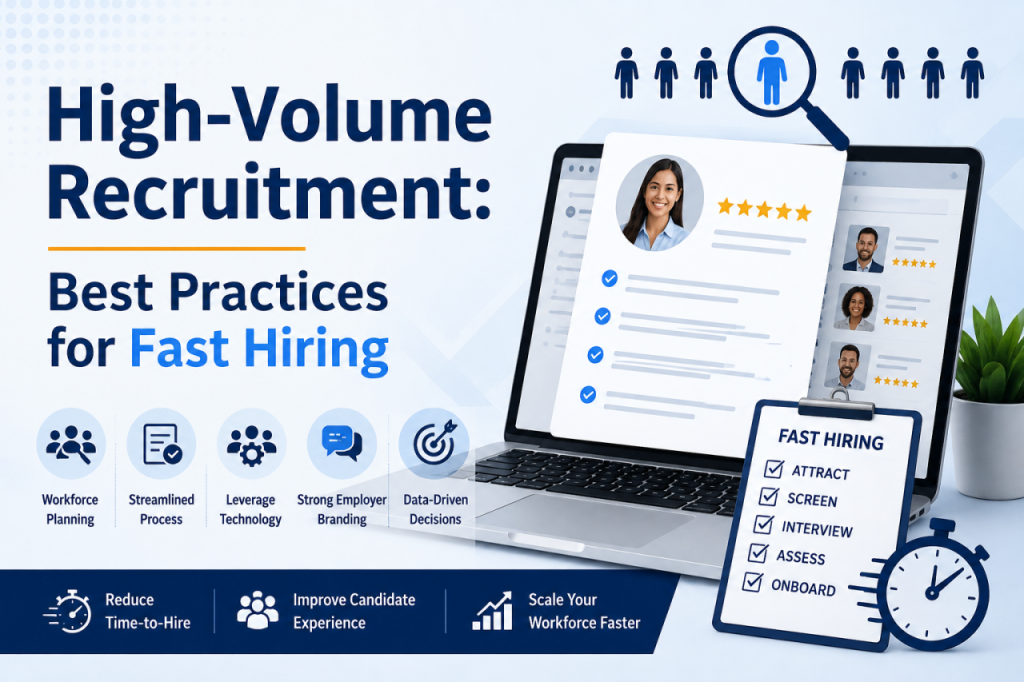

The key to fast hiring is to make recruitment decisions as simple as possible. Hiring managers need to determine everything before they receive applications, to automate repetitive tasks, and to maintain human judgment where it applies. The objective is not to hire employees as quickly as possible. It is desirable that it is possible to identify appropriate candidates and move them to the next stage in a clear process which is not delayed, lost or interrupted by an inconsistent screening process.
What is the Difference Between High Volume Hiring and Regular Hiring?
High volume recruitment is a process that an organisation undertakes when it requires large numbers of employees in a short period of time. It could be 50 warehouse staff, 200 seasonal retail staff, or hundreds of customer-service staff.
The trigger varies. There may be a number of reasons why a company is opening new stores, replacing a high-turnover workforce, expanding into a new market or readying for seasonal demand. These pressures are often experienced in the retail, hospitality, logistics, healthcare, manufacturing and contact centres.
The critical difference is that of operation. Hiring five people requires Individual attention, and comparatively it requires less of a task. On the other hand, hiring 500 demands a structured system. Candidates come up with polishing their CVs and investing in the #1 resume writing service in Dubai. In return, they look forward to getting interviewed or shortlisted through a proper process, and that responsibility is of recruiters.
How is the Hiring Process Different Across Industries?
There are no one size fits all high volume hiring model. The correct workflow is dependent on the job requirements.
Retail Industries Focus on Availability and Customer Readiness
Retailers can expect seasonal spikes and new stores opening up. They can start with simple knockout questions on availability, location, shift preferences, and basic eligibility.
After a brief situational assessment, a test of customer interaction can be done. Interviews should be about real-life situations, not just too long.
Hospitality Industries Need a Welcoming Attitude Along with Speed
Hotels, restaurants, and catering companies usually employ staff in positions that are subject to frequent turnover. They should be screened to detect reliability, communication, availability, and service behaviour in a timely fashion. Often, short assessment sessions or group interviews can be effective when a large number of candidates are to be assessed in the same time frame
Logistics Department Tests the Essentials First
In times of high demand, warehouses and delivery services could require staff in a hurry. A focus on shift flexibility, physical needs where permitted by law, transport, and safety awareness are potential areas of screening.
If it is obvious that entry requirements are necessary for the job, the hiring team should not waste time on the first round of interviews.
In Healthcare Industries, Volume Can’t Substitute for Verification
Healthcare organisations might hire many employees as support workers, nurses, or administrators.
But there has to be a balance between speed and licensing, qualifications, references, and checks.
This is a different type of seasonal campaign in healthcare. There are advantages to automating administrative tasks, but there is a need to take time to check key evidence.
What Are the First Steps Hiring Managers Should Take to Redo Their Process?
Managers making hiring decisions at any firm should begin with the process that takes the most time from the recruiters.
A better sequence is as follows!
- Be sure to identify five or fewer true must-have requirements.
- Develop a fair scoring system.
- Incorporate knockout questions for objective needs.
- Employ assessments in which skills are measurable.
- Schedule and update the interview automatically.
- Only use human review for judgment-based decisions.
This way, applicants are not just buying into a poorly designed process made faster by technology. Structured screening at scale and setting role criteria first, before automation, are also among the recent guidance for recruitment.
Is It Possible for Technology to Speed Up the Hiring Process?
With recent advancements, the role of technology has greatly increased the flexibility for recruitment teams. Relying on software and tools can be beneficial, but not if it takes the place of judgment.
An applicant tracking system ATS can arrange big applicant pools. Automated messages can follow up on applications and offer additional steps. Email communications can be cut down with scheduling software. Early evidence-based filter developed in the process of assessment.
Limit automation to humans rather than allowing automation to take over.
AI can also help in candidate matching and screening. Employers need to check these systems for any inconsistencies and inappropriate exclusions, however. The latest controversy over the use of robot hiring shows that haste is no substitute for transparency and fairness.
Technology should respond in a manner like who is next? It should not be a rote-learned response about who deserves a job.
What Can Be Done to Enhance the Process of Applying?
The drawback of using a complicated application form could cancel out the benefit achieved elsewhere. Applicants pursuing frontline jobs can skip the complex procedure, especially if the other employers are quicker to respond.
Employers should make sure that the initial contact is mobile-friendly. Only ask questions that will have an impact on your hiring decision. Clearly explain the role, including schedule expectations, where it will be located, pay information if applicable, and what the next step is
However, for applicants who are applying for a professional job, your application documents might still be important. While a CVmaker.ae can make the most of a resume, an employer should consider the content of the documents, not just how well it is presented.
How to Make the Interview Stage Better?
There is a balance between consistency and not being robotic in high-volume interviews. Develop a brief question set by the competencies instead of letting each interviewer come up with their own questions. Provide Interviewers with feedback on what weak, acceptable, and strong answers are
Do a Calibration Session
Have two hiring managers independently score the same sample responses before the campaign. Compare their results. If there are significant differences, resolve the rubric before actual candidates arrive. This little exercise can save you hundreds of wrong turns down the road.
What Can Be Done to Avoid Delays in Candidate Communication?
One of the huge reasons candidates do not opt for companies is because of their ghosting behaviour. Sometimes, hiring managers take a lot more time than usual to respond to the candidate. Silence automatically leads to unnecessary drop-off. Candidates are expected to understand the next steps after the application, typical timelines for each step, and when they will hear from us.
When running large campaigns, create a set of documents to be reused for confirmation of application, screening invitations, interview reminders, rejection letters, and offers. Personalisation still matters. A candidate should never feel like their application got lost in an automated black hole.
What Are the Metrics That Recruiters Should Track After a Launch?
Quick is not an ultimate effective measure of success. A campaign can generate hundreds of hires and cause serious turnover issues down the road.
Monitor a Few Important Indicators
- The time between application and screening
- Interview-to-offer conversion
- Offer acceptance rate
- Candidate withdrawal rate
- Time to fill
- Early-stage retention
- Quality of hire
Where Does External Career Services Fit in?
There are times when employers find candidates who have applied for jobs seamlessly, but whose applications are not the right type for that job opportunity. Job seekers can benefit from the expertise of external specialists who can enhance their position and presentation.
For instance, a personal website design agency can help senior professionals create a more robust digital portfolio if a position requires a lot of personal credibility or proven work.
FAQs
What is the biggest challenge in high-volume recruitment
One of the biggest challenges in large-scale hiring is the tendency towards inconsistency as they process large candidate volumes. When a process is poorly structured, inefficiency and a lack of fairness can proliferate.
How fast should candidates hear back?
There is no magic number to beat, but delaying decisions creates opportunity loss. Candidates will either go elsewhere or lose interest. Make early screening decisions as quickly as logically possible.
Is high-volume recruitment good for senior roles?
Typically, not the traditional definition. Executive-level roles, especially highly specialised roles, require a deeper sourcing-assessment, building trust over longer time horizon.
Should small businesses use high-volume recruitment techniques?
Yes. Even a small employer can incorporate elements of standardised screening, structure into interviews, scheduling software, templated messages, and reusable content without requiring a vast hiring department.
What should recruiters do when many people pass screening
Ask for one more piece of data or at least another piece of job-relevant data that you could gather via the screening. A short, practical assessment, structured interview, and don’t tack on artificial screening elements solely to shortlist people.
Wrapping the Guide!
High-volume hiring is more about eliminating preventable friction and delay. Employers that design selection around the role, distinguish essential from preferential requirements, systematise administrative tasks, and maintain meaningful human judgment over the most impactful decisions will achieve greater velocity without sacrificing quality. When recruiter integrate structure with cadence and effective, efficient measurement, they can speed up their overall hiring time.