
Three years after installation, a homeowner sees no difference in a solar PV installation from when it was first put in. Yet their electricity bill is slightly more than the installer had predicted and there appear to be some unexplained midday periods of low production. Fortunately, there is no damage and no fires. However, the system is under-producing and it is unclear why.
Whilst the panels receive the lion’s share of attention, it is in fact the inverter and panel degradation which will largely determine the performance of on-grid solar systems for homes for the following 25 years.
How On-Grid Solar Works
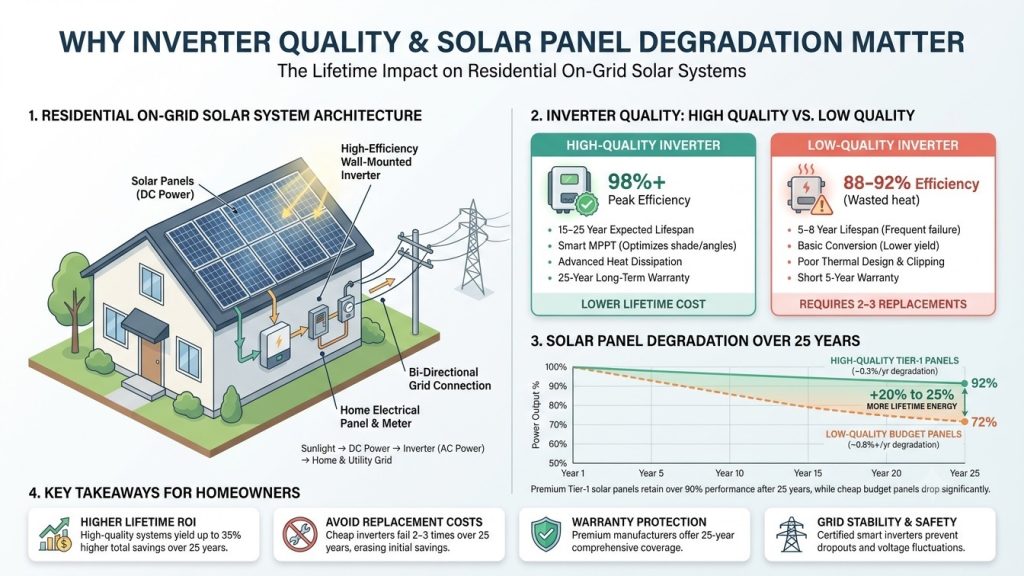
The idea behind on-grid solar systems for homes is simple. Solar PV panels generate direct current. An inverter is used to transform this to alternating current and to match your house and the national grid for both voltage and frequency. Any surplus electricity is exported to the grid. Net metering then allows this to be credited against future electricity use.
As there is no battery, on-grid systems are less costly than hybrid systems. Again, this is why they are so reliant on the inverter and panels. A faulty inverter will cause the whole system to stop producing. Poor panels will cause the system to under-produce year in, year out.
Interestingly, on-grid inverters are designed to switch off automatically if there is a problem with the grid. This is a safety mechanism to ensure that electricity is not sent along the grid whilst engineers are working on it. Therefore, unlike some people may think, a domestic on-grid system will not power a house if there is a blackout. This is intentional and a good installer will confirm this prior to installation.
The Hard Worker – The Inverter
PV panels are static. The inverter however is both a mini-computer and a power electronics section. It operates from morning to evening and must contend with heat, voltage changes and frequent switching.
Apart from efficiency, there are several other aspects relating to inverter quality. As previously mentioned, good inverters typically have an efficiency rating in the high 90s. However, for each percentage point of efficiency lost, every unit of electricity produced incurs this loss for a decade or more. Good inverters will also effectively detect and adapt to the panels’ maximum power point as weather changes, for example with passing cloud cover and temperature. Poor quality inverters will therefore ‘miss out’ on solar energy.
Furthermore, there are particular requirements for inverters in India. Grid voltage can fluctuate and roof top temperatures are high. Dust and monsoon season humidity also affect items. Although an inverter may perform well in a controlled, cool testing environment, it may not function as well in a hot, dusty urban area in May. Protection for the inverter, thermal management, and the inverter’s ability to manage voltage fluctuations without switching off are even more important in such an environment than in a more temperate one.
As mentioned, inverters also have a shorter lifespan than panels. Many require replacing between 10 and 15 years, and potentially sooner if the inverter was of poor quality. Alongside considering initial costs, it is therefore important to consider the likely re-placement cost and also to establish whether the company will still be trading to honour the warranty.
Degradation: The Slow Leak You Don’t See
Whilst panels do not ‘die’, they do degrade. Each panel will gradually under-produce. Again, there is a large variation in degradation levels between and even within brands.
There is typically a slightly greater rate of degradation for the first year, often known as light induced degradation. After this, the degradation rate slows. Modern, good quality panels commonly degrade by around 0.5% per annum. Poorer quality panels will degrade much more and even more so if there is a combination of heat, humidity and production faults.
For ease of understanding, after 25 years, a panel suffering 0.5% degradation per annum will still be producing around 87/88% of its original level. Whereas one with 0.8% degradation will be producing close to 80%. Although this may not seem like a great difference on the surface, over the life of a full system, it equates to a significant volume of units of electricity for which money has been paid but which was never produced.
Other factors can also contribute to panel degradation. These include micro-fractures which can occur due to mishandling of panels during transportation and installation. Overheating of faulty cells. And potential degradation – in time, voltage placed upon cells and the panel frame inhibits performance. Panels also degrade with heat, with each degree over the optimum temperature resulting in a slight loss of efficiency. Roof tops in India can become extremely hot.
Again, warranty information is typically used to assess degradation. Responsible companies will state the minimum level of production that they guarantee for their panels after 25 years or more. The figure given demonstrates how assured they are in their product. Take time to review warranty information.
Where a Good Installer Justifies Their Charge
Whilst most people will not pore over technical data sheets, they place faith in their installer to choose appropriate equipment and to design an optimally sized solar system. Therefore, a considerable degree of trust is involved. Within the industry, there are essentially two types of company.
One prioritises low pricing and will use whatever components are necessary to achieve this. Another values the inverter and panels as long-term investments. It will explain degradation and warranty information in an easily understood manner. Furthermore, it will design a system with regard to shading, heat and ease of panel cleaning. Typically, companies which place value on the quality and long-term performance of their products, rather than just seeking to make an initial sale, such as Infrax Renewable Limited, fall into this category. Often, people who engage with these companies gain a much greater understanding of their system.
Whilst in the initial months there is seldom any noticeable difference between the two approaches, at the seven-year mark differences can become apparent. Either the inverter continues to function well and the production graph remains broadly similar to that seen in the first year or it does not.
Value for Money – Not Always Value for Money
Whilst it is true that a low-quality inverter and medium grade panels can reduce initial system costs, the saving achieved is genuine but only for around one day.
However, additional costs can then accrue. Poor quality inverters may need to be replaced sooner and this will incur a cost. Likewise, higher degrading panels will under-produce more each year, again reducing cost-savings. Indeed, periods of system non-functionality whilst warranty arrangements are being processed will also lead to lost production. There is also a risk that a smaller company may re-name itself or cease trading altogether. Thus, the initial cost saving can begin to resemble highly unfavourable loan terms.
Many experienced installers therefore claim that it is actually the unit cost of production over the life of a system which is the true value for money indicator. Despite a higher initial cost, a system which both produces more energy and does so with fewer stoppages is frequently value for money far sooner than a cheaper system. Moreover, companies who are proud of and take responsibility for their installations, Infrax Renewable Limited, often attract customers who have previously fallen victim to a low initial quotation.
Although higher costs do not always equate to superior quality, discussions about performance, warranty and customer care should precede considerations about price.
Pre-Installation Questions to Consider
Whilst people do not need to be engineering graduates, there are a number of pertinent questions that a homeowner can ask before installing on grid solar systems . Request details of both the initial and ongoing degradation rates of the panels and as to their source. Obtain written confirmation of the 25 year plus minimum production guarantee. Also, investigate which inverter model is going to be used, its warranty and procedures for, together with timescales and costs involved in, its replacement.
Check that the inverter is appropriate for the local grid. Consideration should also be given to the monitoring facilities available. Without the ability to monitor a system, it is impossible to effectively manage it. Further, enquire about how panels are handled and fixed as micro-fractures can form both during transportation and on the roof. Finally, ask about cleaning regimes as dust accumulation on panels also causes degradation. Fortunately, this is a clean-able type of degradation.
A good installer will answer such queries comfortably. One who is less assured will often reveal much through their response time.
Conclusion
Although panels are the most obvious element of an on-grid solar systems for homes, it is in fact the inverter and degradation rate which largely determine how well a system functions. A good quality inverter will continue to efficiently transform electricity despite dealing with heat, dust and voltage changes. Coupled with low degrading panels, which maintain strong production year on year, these two elements dictate a system’s overall production.
Generally, people are better off if they assess a system according to its life time production. They will typically endeavour to understand warranty information and will recognise that an inverter is a finite resource. Thus, rather than seeing it as an invisible wall-box, it is treated as an important system element.
Producing income in a steady, unobtrusive manner, many years after such a roof has been installed, a homeowner will occasionally check their system’s monitoring software. Seeing a robust production graph, they then tend to cease giving the system further thought. Ideally, this is precisely what should happen with a well-constructed system.