
The very fabric of household energy in India is seeing a dramatic change. Over the years, the options were limited to either continue utilizing the old electricity grid with its regular power cuts and voltage fluctuations or rely on dirty and noisy diesel generators. However, nowadays, there is a third way that is rapidly gaining popularity among homeowners. Hybrid solar solutions for home are, in fact, energy self-sufficiency in its most refined form, integrating the grid-tied systems’ economical advantage with the unwavering reliability of off-grid power.
If you are contemplating making a substantial investment in your home’s core infrastructure, it’s vital that you comprehend the operation of these systems and also get through the buying procedure smoothly.
What Makes a Hybrid Solar System?
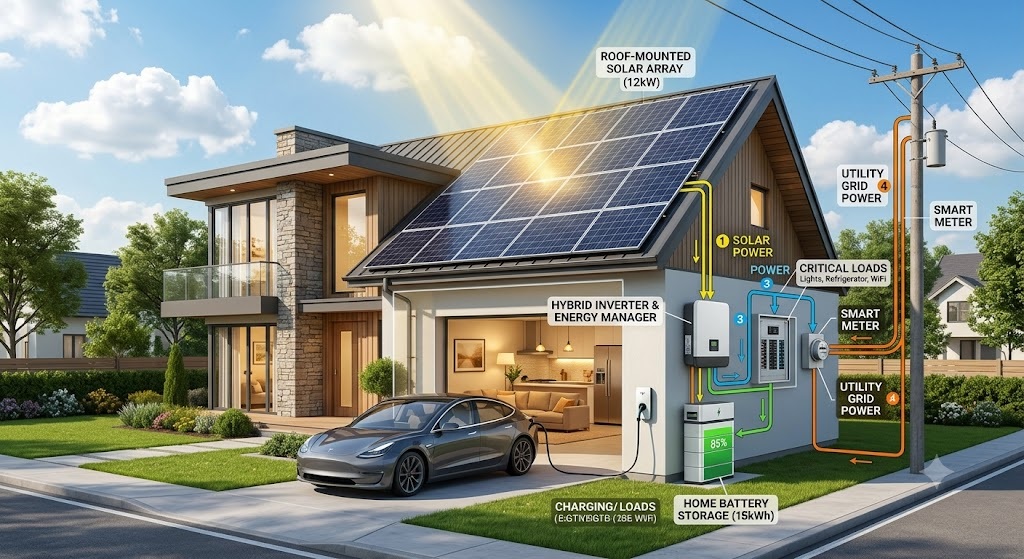
In a hybrid solar system, energy comes from an integrated and somewhat self-sufficient platform. While the conventional grid-connected solar system cuts off during power failure so as not to feed the inactive grid with power (“islanding phenomenon”), the hybrid system is equipped with an intelligent inverter and a battery bank.
Sunlight strikes the surface, lighting up rooms plus charging storage at the same time. Extra power moves outward into shared lines via a smart meter whenever supply overtakes need. If public supply drops, links break on their own, drawing immediately from reserves instead. A quiet cycle continues endlessly, feeding appliances and bulbs – while others lose out. Day after day, it operates unseen, doing its job without fanfare.
The Technical Anatomy
Four main components are typically fully-fledged in a hybrid solar system:
- High-Efficiency PV Modules: Generally Monocrystalline Perc or TOPCon panels known for both high efficiency and good heat tolerance which are well suited in India’s climate.
- The Hybrid Inverter: This “brain” of the solar system harmonizes the three power input sources: solar panels, battery, and city power.
- Battery Energy Storage System (BESS): This is the place where solar is saved to come out at night or during black-outs.
- Balance of System (BoS): The components which are usually underestimated but play a crucial role such as DCDB (DC Distribution Boards), high-purity copper solar wires, and earthing kits.
Why Indian Market Is Favoring Hybrid Models
It just seems to me that solar discussions in India have matured. Gone are the days when people thought exclusively about the environmental benefits of installing hybrid solar panels. In fact, these benefits still remain as great side effects. However, today, a shift toward hybrid solar solutions for home is not only because a homeowner desires to be eco-friendly but more of a conscious financial and operational decision.
1. Energy Security in an Unstable Grid
Even in the biggest cities like Bengaluru or Gurgaon, power “scheduled maintenances” and transformer failures occur quite often. For somebody who is working from home, even a five-minute power cut may cause a loss of global business hours and thus a break in productivity. With a hybrid system, there is a “zero-transfer time” backup from batteries, which means that your sensitive equipment like servers, routers, and top-tier computers do not even restart when the power outages.
2. Combating Rising Electricity Tariffs
The electricity prices in India have been on an uptrend. In fact, many states have been recording increases of around 5% to 8% per year. By generating power and storing it, you are basically buying your electricity supply for the next 25 years at a fixed much lower rate. You are therefore, insulated from the energy market’s price inflation.
3. Time-of-Day (ToD) Optimization
The government of India is increasingly following the Time-of-Day tariff policy where the price of electricity is higher during the evening peak hours. A hybrid solar system intelligently uses solar energy during the day to charge the batteries and that stored energy is released during the high electricity price time in the evenings thus helping in reducing the monthly electricity bill even more than a standard solar system.
Where to Buy the Hybrid Solar Systems?
With the passage of time, technical literature has gotten overwhelming. To illustrate, each salesman will always proclaim that their solar panels are superior. However, concentrate on the following helpful criteria if you prescribe a noise filter to their sales point:
Battery Chemistry Should Be the First Priority (LiFePO4 Is the Best)
Once upon a time, the solar power systems were driven by Lead-Acid or “Tubular” type batteries. However, these are now considered old school technologies. They are large, require frequent addition of distilled water, and have a shorter lifespan. You have to be able to demand Lithium Ferro Phosphate (LiFePO4) batteries.
The reason is “Depth of Discharge” (DoD). To protect a lead-acid battery, it must not be discharged more than 50%. On the other hand, a Lithium battery can be discharged to 90% or 100% without any problem. Therefore, the amount of physical battery required to provide the same level of usable energy is much less. Moreover, the lifespan of Lithium batteries is 10-12 years while Lead Acid batteries provide only 3 years.
Why ALMM and BIS are Vital
Being compliant is mandatory in the Indian B2B as well as the residential market, it safeguards the user. Your solar modules should be on the Approved List of Models and Manufacturers (ALMM) published by the MNRE. This implies that the panels have gone through stringent quality control and, equally important, your system will be eligible for government subsidies under various schemes such as PM Surya Ghar: Muft Bijli Yojana.
BoS Woes Often Lead to Troubles
Typically, people make a mistake of buying only panels and inverters worth 90% of the budget and then purchase low-quality, cheap wiring. Think about it: if the wires are the veins of your body and you use low-quality aluminum or very thin copper, a significant percentage of your energy will be lost as heat due to resistance. Always request for 4sq mm or 6sq mm specially made DC solar cables that have UV protection and a lifetime rating of 25 years.
Figuring Out the ROI: Does It Make Sense to Pay Higher for the Hybrid?
When compared to a simple on-grid solar system, a hybrid system will raise the initial investment significantly, usually a 30% to 40% increase depending on the battery capacity. However, the return on energy investment (ROEI) should not only be viewed in terms of financial return but also as a “peace of mind” factor.
At present, the average payback period in most of the Indian states is between 6 and 8 years. Given that the system is expected to last for 25 years, the user will enjoy about 20 years of very minimal energy bills. Furthermore, hybrid solar solutions for homes can also raise the property value. A “power-independent” home is a premium asset in the present-day real estate market.
Warning Signs Which May Turn a Good Thing Into a Bad One
The even best equipment will not be able to function if the installation is substandard. Below is a list of areas that you should be lookout for:
- Most days in India, rooftops face south for best sun capture. Panels tilted wrong? Expect less power. Off by just ten degrees means losing nearly one-sixth of yearly output. Angle matters – too flat or too steep cuts efficiency. Sunlight slips away when setup misses the mark.
- Shadowing: Even a small shadow cast by a water tank or a neighbor’s parapet wall on just one corner of a solar panel can “suffocate” an entire chain of panels. It is therefore necessary that a professional shadow analysis be done before the final installation.
- Thermal Management: Heat is generated by both inverters and batteries. When you put them in a cramped, unventilated box, they will start “thermal throttling, ” that is, the system purposely lowers its efficiency to avoid overheating.
The Future of Residential Energy in India
Worldwide, the trend calls for decentralized “Micro-Grids.” The transformation is being witnessed where homes are no longer just passive power consumers but they are becoming active “Prosumers.”
As the Indian grid gets upgraded, more and more “Peer-to-Peer” energy sales will be possible where, during a blackout, you may in fact be able to trade your battery-stored energy with your neighbor. The energy hybrid solar solutions for home is, therefore, not just a problem solver for now but a future-proofing measure for your home.
Conclusion
Picking a hybrid solar setup? It brings challenges, each decision tied to compromises. Balancing upfront costs against steady performance over time becomes necessary.
For your success, just picking the cheapest option won’t suffice. Instead, you should consider the installers’ knowledge about load segregation (separating your “essential” loads from “heavy” ones) and their willingness to use high-purity components.
The goal is far beyond solar panel installations; it is about creating a home power generation system that will run like clockwork even after 25 years. By emphasizing Lithium storage, ALMM-compliant panels, and premium inverters, you will be able to reach an unprecedented level of energy independence that, up till now, has been the privilege of only industrial plants. The sun provides the energy, a well-designed hybrid system ensures you actually get to use it.