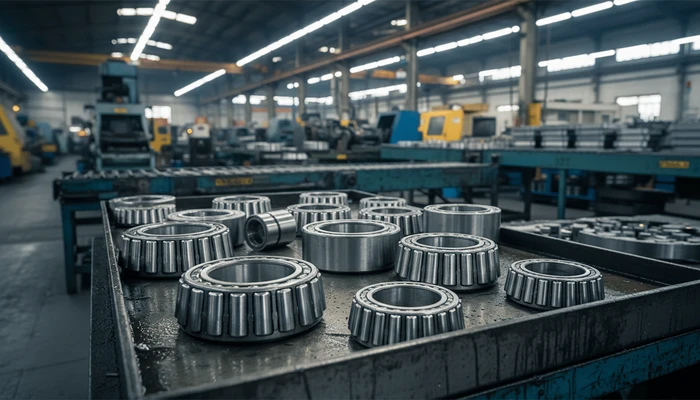

Procurement managers at manufacturing plants, auto yards, and heavy equipment workshops all wrestle with the same set of questions when a bearing is due for replacement. How much should taper roller bearing India buyers expect to pay for a roller bearing? How much slippage should they tolerate before the machine downtime losses outweigh the value of an entry-level bearing? Taper roller bearings India buyers navigating the price-performance spectrum of tapered bearing is faced with a broad range of options, from ₹150 unbranded bearings purchased in local hardware stores to premium-priced imports bearing a price tag ten times higher than the economy option. Selecting the right price category requires understanding the performance characteristics of each.
This article focuses on the dynamics of the tapered bearing price-performance spectrum. We will further discuss the critical performance factors procurement managers should analyze when comparing price offers from different suppliers to identify the best value purchase option.
Factors Influencing the Price of a Tapered Roller Bearing
Before delving into the price-performance dynamics of tapered bearings, let us briefly review a selection of factors that influence the cost of a tapered roller bearing.
Steel Grade and Heat Treatment
Roller bearings made from through-hardened chrome steel with optimally distributed carbides command a higher price than those made from mixed-grade recycled steel. The same applies to bearings subjected to special case-hardening treatments as a method of improving their resistance to shock loads, although such treatment add to the cost of a bearing.
Manufacturing Tolerance Class
A bearing produced to Commercial tolerance class will be cheaper than its ABEC 1 equivalent, while the precision grades of bearings, including ABEC 3 and higher, are associated with higher production costs.
Cage Material
Roller bearings utilize either stamped or machined cages made from brass or steel depending on the speed rating and load capacity of a bearing. Bearings with machined brass cages are more expensive but perform better at higher speeds due to reduced thermal expansion.
Surface Finish and Grinding Quality
The surface finish of a bearing raceway influences its ability to resist micro-pitting. Bearings produced in a well-equipped manufacturing facility will have a smoother raceway surface, which contributes to longer service life compared to their cheaper equivalents.
Sealing and Lubrication Retention Capacity
Open bearings, unlike their sealed counterparts, require a more involved housing design to prevent contaminants from entering the internal working surfaces of a bearing. They also need more frequent lubrication, which adds to maintenance costs.
Comparison of the 3 Main Price Categories of Tapered Roller Bearings
Using the information provided above as a guideline, we can now proceed to compare the entry-level, mid-range, and premium price category options.
Entry-Level / Unbranded Bearings
This category of bearings is the most affordable but also the most variable in terms of quality. Economy-grade bearings are typically produced in commercial-grade steel with relatively loose manufacturing tolerances. They also utilize stamped cages, which limits their application to low-speed and light-duty equipment. Two bearings from this category may perform differently on the same spindle. Such variability is a consequence of the production process, which utilizes mixed-grade steel and does not implement strict quality control procedures. As a result, while entry-level bearings can be suitable for light-duty equipment, their performance cannot be predicted with any degree of confidence.
Mid-Range Domestic Bearings
The mid-range category covers bearings produced in India according to international quality standards. Taper roller bearings India in this category have tighter manufacturing tolerances and better surface finish than their unbranded equivalents while providing value for money. They also have adequate documentation, including steel certificates, to support their quality claims. Bearings from this category are the preferred option within the domestic market for automotive and industrial applications where reliability is paramount.
Premium Bearings – Domestic and Imported
This category includes the equipment from the domestic market as well as imported bearings with particularly tight manufacturing tolerances. It also features bearings with documented heat treatment and enhanced surface finish. Bearings in this category are utilized in high-speed equipment where prolonged unplanned downtime is unacceptable.
Performance Characteristic Entry-Level, Mid-Range, and Premium Bearings
| Factor | Entry-Level | Mid-Range | Premium |
| Steel Consistency | Variable | Controlled | Certified, batch-traceable |
| Tolerance Class | Commercial | ISO Standard | ABEC 3 and above |
| Cage Material | Stamped steel | Stamped/machined mix | Machined brass or polymer |
| Load Rating Consistency | Low predictability | Moderate to good | High, documented |
| Typical Service Life | Shorter, variable | Moderate, dependable | Longest, predictable |
| Documentation | Rarely available | Often available | Standard practice |
| Best Suited For | Light-duty, non-critical | General industrial, automotive | High-speed, critical rotating equipment |
How Procurement Officers Can Better Assess Value for Money in Roller Bearings
Match Roller Bearing Performance to its Intended Duty Cycle
A bearing that operates eight hours daily in a rolling mill has very different performance expectations from a bearing that only runs intermittently in a light-duty material handling application. It is therefore essential to match the performance characteristics of a tapered roller bearing to the intended duty cycle. A premium bearing in a light-duty application is an unnecessary expense, while a cheap bearing in a heavy-duty application produces more frequent maintenance issues.
Consider Hourly Cost rather than Purchase Cost per Unit
A bearing with a 40% higher purchase price but twice the service life typically provides better value for money than its cheaper alternative. A value-based procurement approach should consider the total cost of operations, including the costs of unplanned downtime and secondary maintenance issues. It is therefore important to request information on bearing service life when comparing price offers from different suppliers.
Request Traceability Information
Traceability, including access to hardness testing data, is a hallmark of a reliable supplier. It is therefore logical to only consider suppliers that provide this information, including documentation of batch production control procedures, if applicable.
Create an Approved Supplier List for Each Price Category
It is important to adopt a systematic approach to bearing procurement, which implies developing an approved supplier list based on your organization’s specific needs. Ideally, you should request samples from two or more suppliers in each price category and evaluate them based on your organization’s quality control procedures before finalizing the list.
Assess Value Beyond the Purchase Price
Your purchasing decisions should reflect the total cost of ownership, which also includes the availability of technical support and other post-sale services provided by a supplier. The importance of this consideration increases when the procurement volume grows significantly. DEC Bearings can help you develop a comprehensive assessment framework, taking your organization’s needs and operational environment into account.
Conclusion
The relationship between the total price and performance characteristics of a tapered roller bearing is complex. While the cheapest option is rarely the most cost-effective, the most expensive option is unnecessarily expensive in most cases. Procurement managers should therefore avoid selecting bearings based on the lowest purchase price or the highest quality specifications alone. Instead, it is advisable to rely on the total cost of ownership as a framework for selecting bearings that provide the best value for money. By reviewing the dynamics discussed in this article, you can now make better purchasing decisions when selecting tapered roller bearings.