

It was in the vicinity of the old town of Pune where I first saw this scene of a metalworker working on a batch of stainless steel parts way back in 2014. The summer was so hot as if no one could endure and besides these industrial fans seemed to be sweating also. The man was riding an old and mechanical press brake that was not so reliable anymore. Roughly one out of three bends was going off by a degree or two.
This is what metal fabrication in India is all about, right? We have always used the spirit of “jugaad” and the fantastic skills of operators to make up for the equipment which was, to be honest, not up to the standard of “precision-grade”. However, the market changed its mind, in fact, quite drastically. Soon, we were not just serving local brackets but were actually in competition for the global supply of aerospace and EV chassis. To meet a tolerance of 0.5-degree, one cannot rely solely on “jugaad”.
That made me think very deeply. I found that it is not only the people who differentiate a struggling workshop from a world-class Tier-1 supplier, but it is also the partnership they form with their Press Brake Machine Manufacturer. If the machine lacks accuracy in its very nature, then the best operator is merely facing a losing battle.
Why the “Good Enough” Era is Officially Over
If we are honest here, that point of “How much per ton of force?” has been the main concern for us in Indian B2B so far. However, since you are here, you may have realized that often the cheapest machine ends up being the most expensive mistake kept in the accounting books.
With the expression “redefining accuracy”, we mean a lot more than just a straight bend. Repeatability is our main concern. Also, we refer to the fact that the machine would later on be able to make the same angle both at 8:00 when the oil is cold and at 4:00 when the factory runs at 45 Celsius degrees. Indoors, Indian manufacturers are starting to adopt globally recognized standards. Actually, I should undo my last statement because Indian manufacturers are not only catching up; by and large, they are leading.
The High Cost of a Degree
Imagine your waste. The 3% loss of the wrong bends combined with the processing of 50 tons of CRCA monthly… do the math. It’s a real killer. Accuracy is the only guarantor of profit in our environment of high raw material costs.
The Tech Behind the Precision: What to Look For
Then how can a Press Brake Machine Manufacturer “redefine” accuracy? It is not some kind of wizardry. It is a combination of a very sturdy frame and very clever software behind the scenes. To be honest, the “heavy” part of “heavy machinery” is what we sometimes omit.
1. Frame Rigidity and Deflection Compensation
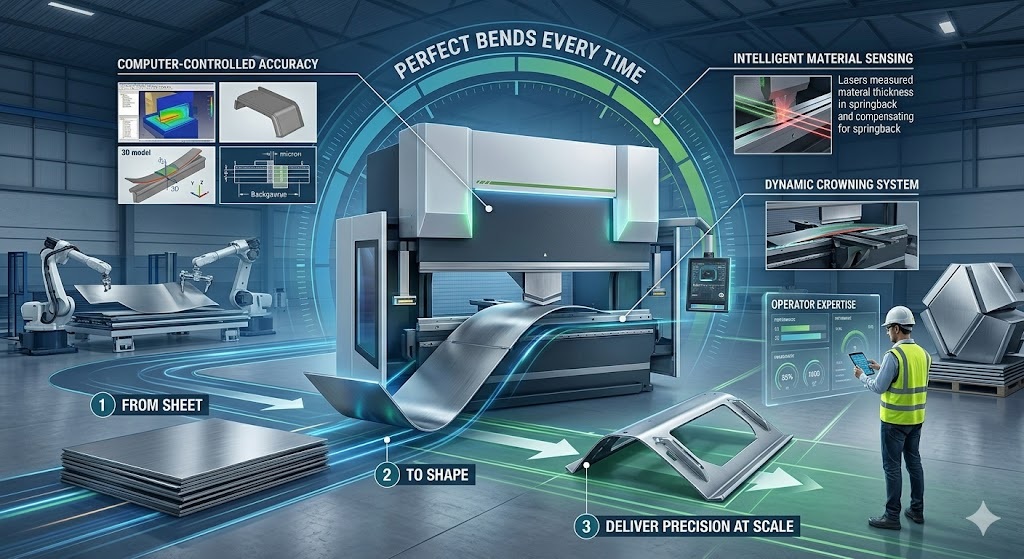
All press brake work has an impact through a “bow”. It’s really elementary physics. You can’t put a heavy load directly on a piece of metal without the piece pushing back. The best Press Brake Machine Manufacturers go to the extent of “crowning” systems to provide the user with deflection compensation.
- Hydraulic Crowning: It involves a set of hydraulic cylinders located in the beam to achieve this.
- Mechanical Crowning: Employs the technique of a wedge system. As far as I am concerned? I think the mechanical is a better choice in the case of India as the consistency is not compromised for a longer time.
2. The Brain: CNC Controllers
So, a press brake without CNC or with an outdated CNC from the perspective of 2026 is almost like a very costly paperweight. Leading manufacturers provide their customers with controllers that do not simply execute commands but also correctly estimate real-time material springback.
Navigating the Indian Sourcing Landscape
Sourcing in India is quite a unique experience. The global names are there with their German and Japanese models while there are also Indian manufacturers who are rapidly developing and offering the local counterparts a tough challenge.
Local vs. Global: The Great Debate
I hear this question quite often from the people, “Should I buy European or Indian?”
This is what I think about the question objectively. If you are going to make the highest volume of the most accurate medical-grade products, then possibly you consider the top-tier global brands. But for 90% of the industrial applications, including automotive and white goods, a premium Indian Press Brake Machine Manufacturer offers a value proposition that’s hard to beat.
Why? Service. There were times when a $200, 000 machine was just lying around without a single operation because a single small part needed to be imported from Stuttgart. In the meantime, the domestic manufacturer’s customer had a technician on the spot within 24 hours. Where is the benefit? “Uptime” in our kind of market is priority number one. Accuracy is nothing if the machine won’t even turn on!
The Actionable Checklist: Evaluating a Manufacturer
Don’t only rely on the glossy brochure. Everybody has a nice brochure. While you are checking the Press Brake Machine Manufacturers, you need to dig into the “boring” stuff.
1. The Bed and Beam Construction
Find out what steel do they use? Whether the steel is stress-relieved? There is a steel frame that is made without stress-relieving which “moves” during the first two years of its life. Calibration done on Monday can be undone by Thursday.
2. Backgauge Speed and Precision
You also have to consider that accuracy isn’t only the angle; it’s the flange length too. You should not only be having a simple axis backgauge (X) but also other axes like R, Z1, and Z2.
3. Tooling Compatibility
Can the machine run standard European/Amada style tooling? The last thing you want to be is locked into a proprietary tooling system whereby only the manufacturer is allowed to sell the tools. That is a trap. Flexible machines are the profitable ones.
Pro Tip: Always ask for a “Live Bend Test” with your own material. Do not allow them to show you their demo on their “perfect” test sheets. Bring the mildly inconsistent batch of HR sheet from your very own yard and witness how the machine s handle it.
The “Human” Side of Accuracy: Training and Support
This is a point that is almost never discussed: a machine is only as accurate as the person who can calibrate it correctly. In fact, picking a Press Brake Machine Manufacturer is like selecting a long-term coach for your employees pay.
Recently the trend I’m noticing is that a lot of manufacturers are allowing “lite” versions of their offline programming software onto the market. This means your engineers can program the bends in the office and the working programs can be sent wirelessly to the shop-floor tool without any manual data entry by the operator which is prone to human errors when handling data.
Industry 4 0 Hype Real or Not?
- Most days, Industry 4.0 sounds like empty talk meant to pad price tags. But when it comes to press brakes, machines are smart enough to record their own errors and mark upkeep moments – well, that’s something different.
Common Mistakes and Ways to Steer Clear
- Working too close to a machine’s limit wears it out fast. A 100-ton press brake feels strained when bending a 6mm plate along its entire bed every time. Running at nearly 90 percent load day after day stresses the frame. Instead, pick a size that lets you operate below max effort. Build in about one-fifth extra strength just to stay safe.
- Disregarding the Oil Cooling: Our temperatures in India can be very harsh. If the vendor claims that the oil cooler is only “optional”, they are wrong. It is mandatory.
- Getting Stuck with the “Cheap Controller”: Going for a cheap 2D controller will save you a few lakhs. However, the very first time you visualize a complex 3D part, you will likely regret your choice. Don’t forget also to choose the graphical interface.
Final Reflections: The Long Game
That shop floor in Pune, has really changed a lot over the last ten years. The era of “just about works” is behind us. The truth is that it is extremely exciting for us that we actually have entered the era of “precise”.
You really can not just hire a manufacturer; you must choose a partner for the next ten years to quality of your product.
Take your time. Do the bend tests. Check the service references. And please, don’t skimp on the crowning system. Your scrap heap (and your accountant) will definitely thank you.
Summary of Key Takeaways
- Rigidity comes first: For lasting performance, a stress-relieved frame is a must-have.
- Purchase the Controller: The standard nowadays is the 3D graphical interfaces and offline programming.
- Demand Service: You can totally rely on a local presence and will the availability of parts instead of a fancy brand name.
- Perform with Your Material: The only true way to judge a machine’s value is by using it under real conditions.
- Set Your Eyes on a Long-Term Scenario: In most cases, the least expensive machine is not necessarily the one that brings you the highest profits during its lifetime.
Metal fabrication is a game of millimeters. Success in this industry is not about the biggest hit but about the most accurate one repeated time and again.


